You Are Asking the Wrong Question
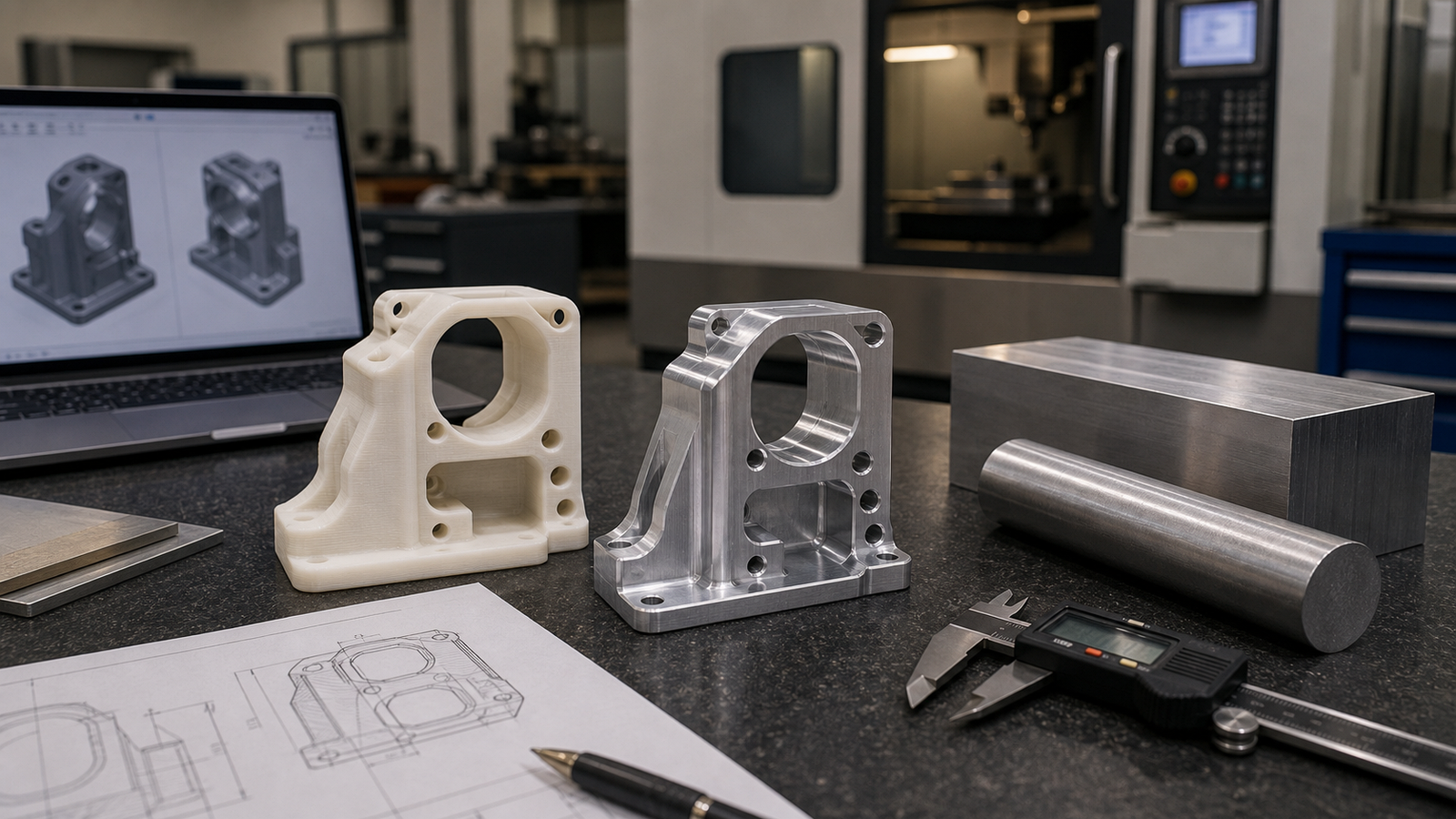
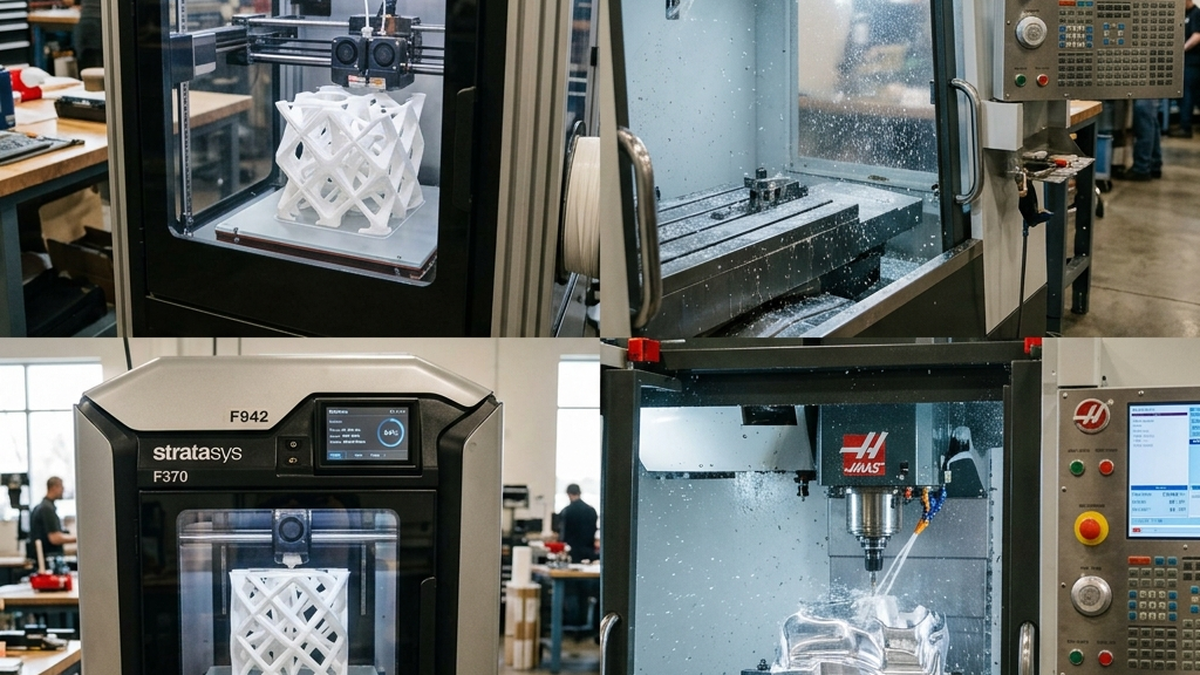
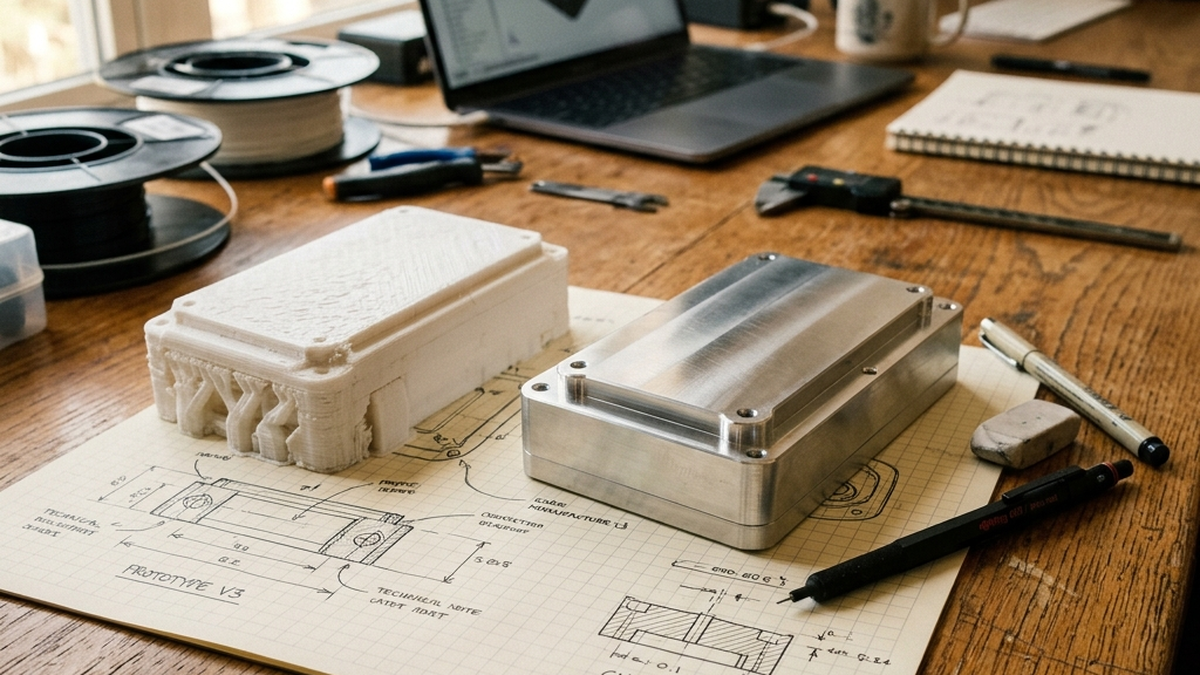
Most engineers ask "should I 3D print or CNC machine this part?" That is the wrong starting point. The right question is: "what does this prototype need to do?"
A visual model for a stakeholder presentation has completely different requirements than a functional prototype going into a vibration test. The manufacturing method should follow the requirement, not the other way around.
This guide gives you a structured decision framework. Answer five questions about your project and the right manufacturing method becomes obvious. No guessing, no defaulting to whatever you used last time.
For a detailed head-to-head comparison of costs, tolerances and materials, see our complete 3D printing vs CNC prototyping guide. This article focuses on the decision process itself.
The 5-Question Decision Flowchart
Walk through these five questions in order. Each one either points you toward 3D printing, CNC machining, or tells you to keep going. If any single question points strongly to one method, that is usually your answer.
Start at Question 1. If the answer clearly points to one method, stop there. If you are unsure, move to the next question. By Question 5, you will have a clear answer. If multiple questions point in different directions, weight Questions 1 and 3 most heavily -- material and functional testing requirements almost always override cost and speed considerations.
Here is the flowchart in plain language, designed so you can apply it to any part on your desk right now:
- Does the part require a specific engineering material? -- If yes, go to CNC. If any plastic is fine, consider 3D printing.
- Are any tolerances tighter than ±0.005"? -- If yes, CNC machining. If all tolerances are ±0.010" or looser, 3D printing can work.
- Will this prototype undergo functional or structural testing? -- If yes, CNC machine it in the production material. Printed parts will give you misleading test data.
- Do you need more than 5 parts? -- If yes, CNC machining is likely cheaper per part. If you need 1-3 for a quick check, 3D printing saves money.
- Does the geometry have internal channels or features a tool cannot reach? -- If yes, 3D printing is probably the only option. Otherwise, CNC can handle it.
Question 1: What Material Does the Part Need?
This is the most important question and should be answered first. Material drives everything: strength, weight, thermal performance, corrosion resistance and regulatory compliance.
Choose CNC Machining If:
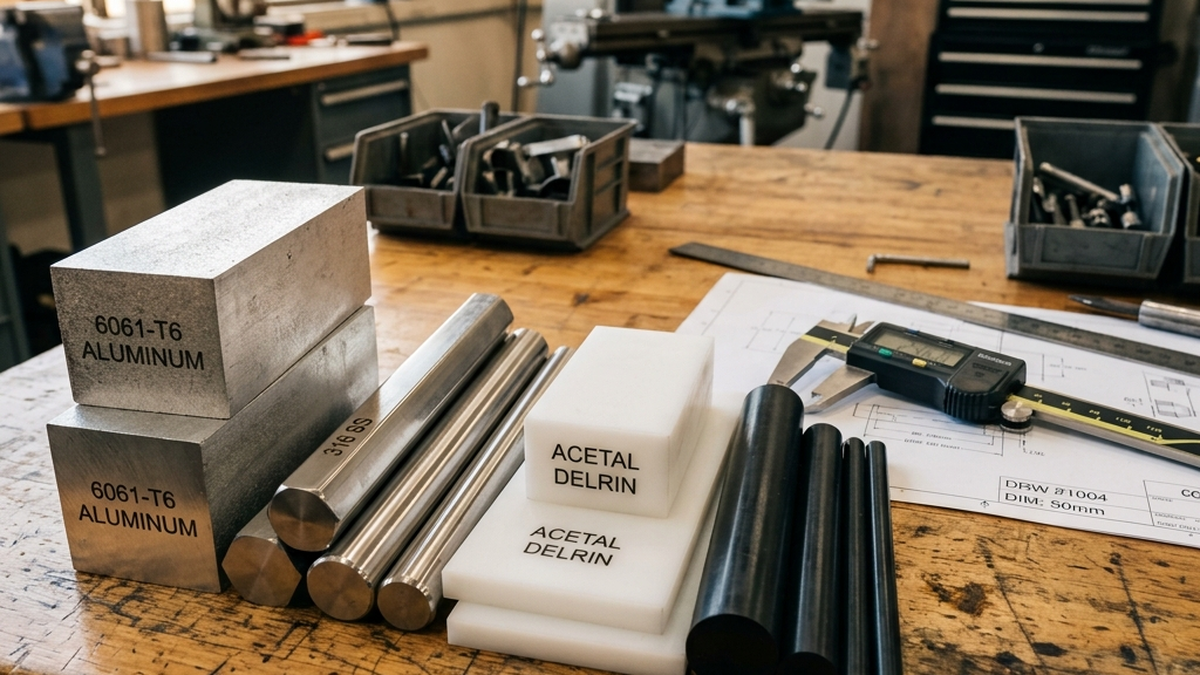
- You need a specific aluminum alloy (6061-T6, 7075-T651)
- The part requires stainless steel (303, 304, 316L, 17-4 PH)
- You need titanium (Ti-6Al-4V, Grade 2)
- The design calls for engineering plastics (PEEK, Delrin, UHMW, polycarbonate)
- You need material certification (mill certs, heat lot traceability)
- The part must match production material properties exactly
Choose 3D Printing If:
- Any rigid plastic will work (PLA, ABS, nylon are all acceptable)
- You are making a visual model or form-check only
- The part is a jig, fixture, or tool that does not carry significant loads
- You need a complex metal geometry that cannot be machined (DMLS is the only metal option)
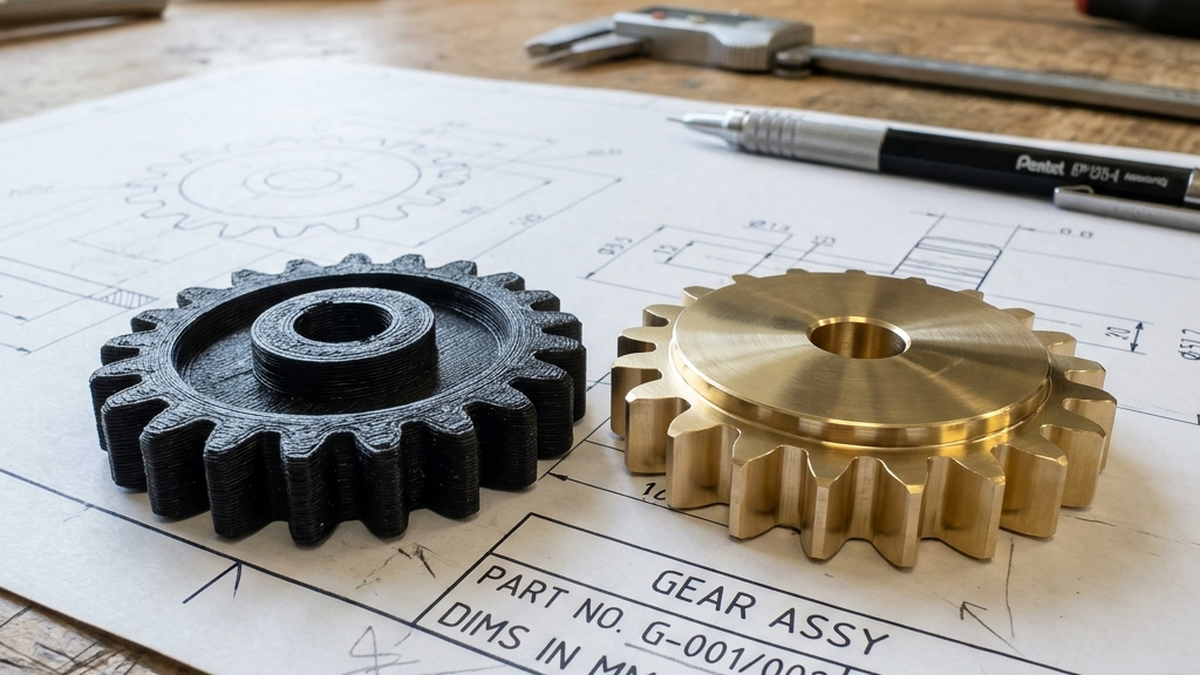
When in doubt, ask yourself: "If I test this prototype and it passes, will I trust the results?" If the material is different from production, the answer is probably no. For a deeper dive on material options, see our rapid prototyping materials guide.
Not sure which method is right for your part?
Upload your CAD file and our engineering team will recommend the best approach -- CNC, 3D printing, or both.
Upload CAD for Free DFM ReviewQuestion 2: How Tight Are Your Tolerances?
Tolerances determine whether your parts fit together and function correctly. The gap between 3D printing and CNC machining is significant.
| Tolerance Range | Recommended Process | Why |
|---|---|---|
| ±0.020" or looser | Either works | Both processes easily achieve this range |
| ±0.010" | 3D printing (SLS/SLA) or CNC | Good SLS and SLA printers can hit this. CNC is guaranteed. |
| ±0.005" | CNC preferred | 3D printing is at its limit. CNC hits this with no effort. |
| ±0.001" to ±0.002" | CNC machining only | No 3D printing process can reliably hold this range |
| ±0.0005" or tighter | CNC with grinding | Precision machining territory. Only subtractive can do this. |
If any single feature on your part requires better than ±0.005 inches, CNC machine the whole part. Mixing processes (print the body, machine the critical features) is possible but adds cost and complexity that rarely makes sense for prototyping.
Question 3: Will You Test This Prototype Under Load?
This question separates form-check prototypes from engineering validation prototypes. They serve fundamentally different purposes.
Form Check Prototypes (3D Print)
You want to hold the part, check ergonomics, verify fit in an assembly, show it to stakeholders, or check packaging. No loads. No performance requirements. The cheapest, fastest method wins.
Functional Prototypes (CNC Machine)
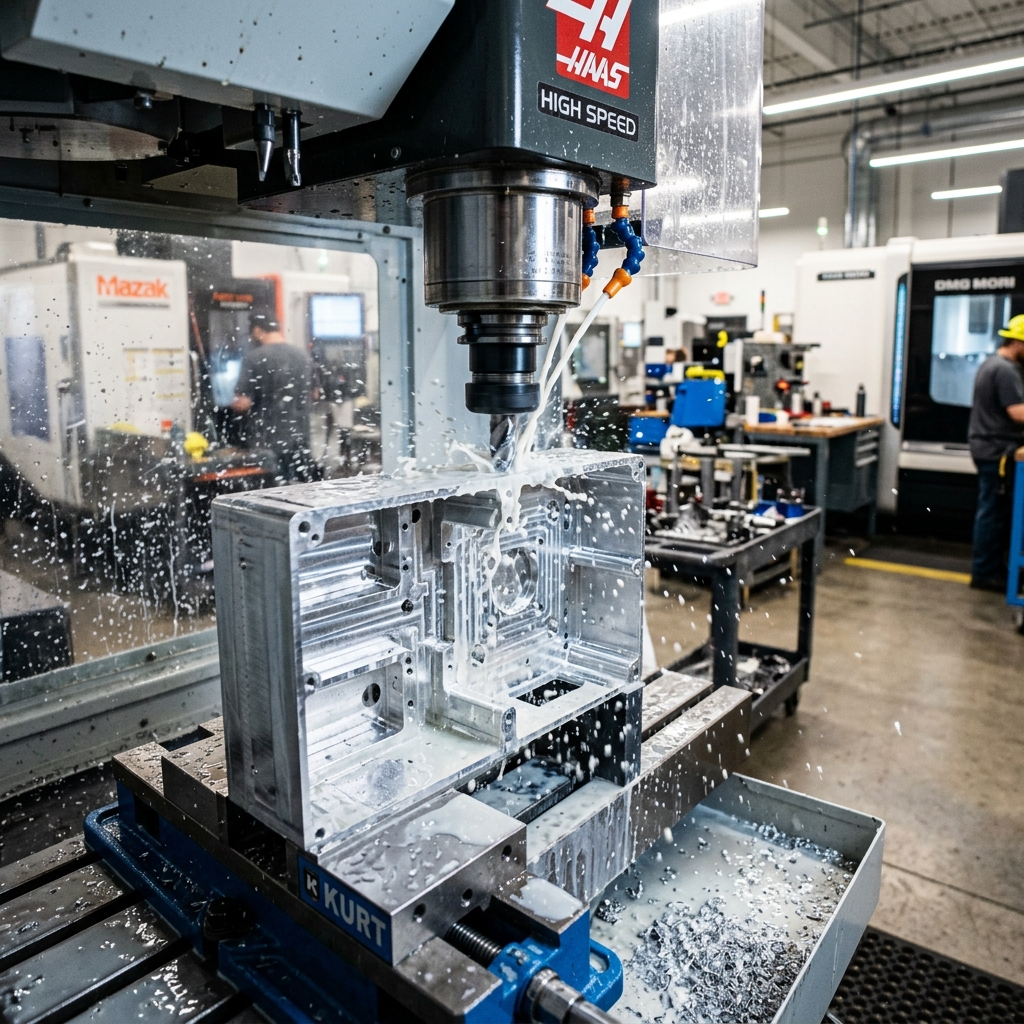
You plan to test the prototype under real or simulated operating conditions: structural loads, vibration, thermal cycling, pressure, fatigue, or wear. The prototype must behave like the production part, or the test data is meaningless.
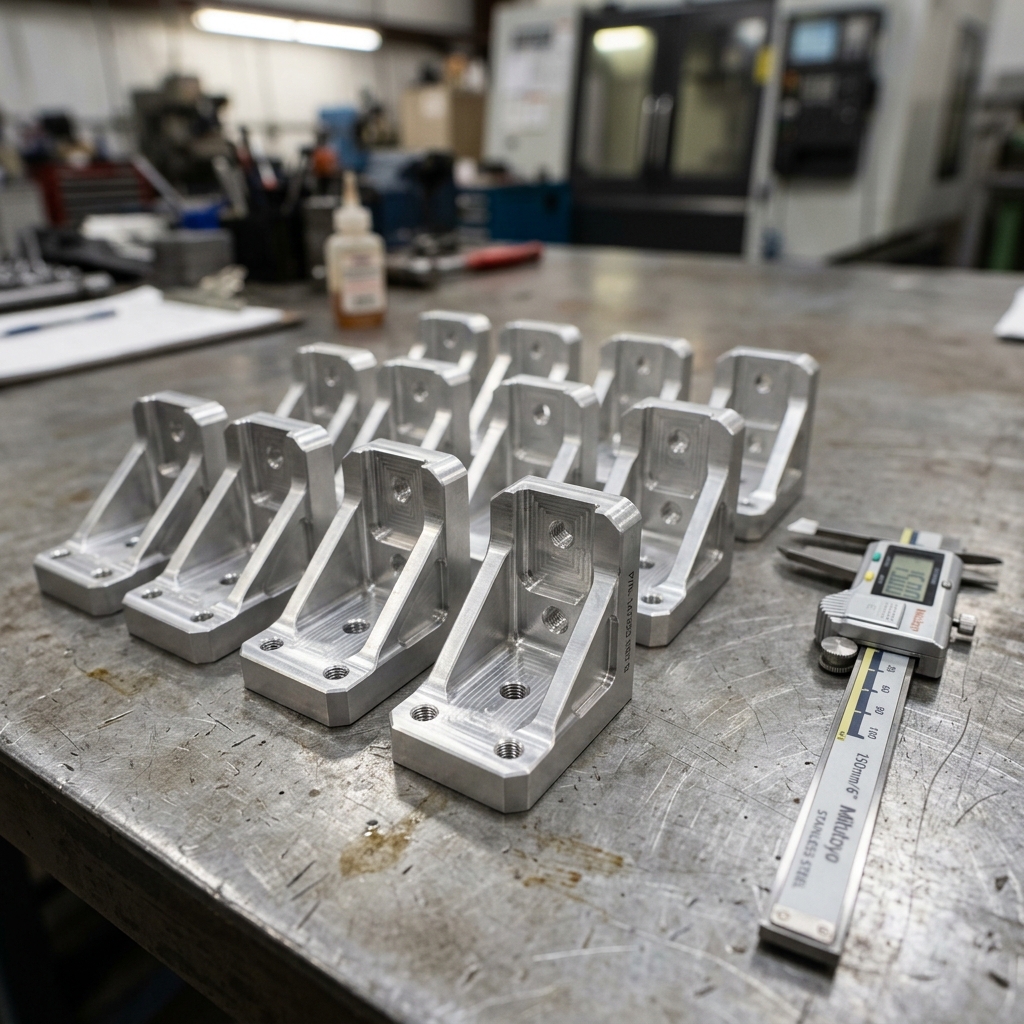
A 3D printed bracket that survives a static load test might fail a fatigue test at one-tenth the expected cycle life because layer adhesion creates crack initiation sites that do not exist in a machined part. Testing a printed prototype and trusting the results for a machined production part is a risk most engineers should not take.
If the test results will influence a design decision, machine the prototype in the production material. If the test is just a sanity check, print it.
CNC prototypes in production materials
Aluminum, stainless, titanium. ±0.001" tolerances. Ships in as few as 3 days.
Upload CAD for Instant QuoteQuestion 4: How Many Parts Do You Need?
Quantity affects per-part cost because CNC machining has a higher fixed setup cost that gets amortized across more parts.
| Quantity | Best Option | Reasoning |
|---|---|---|
| 1 part (form check) | 3D printing | Lowest total cost for a single non-critical part |
| 1-3 parts (engineering samples) | Depends on material | CNC if you need real materials; 3D print if plastic is fine |
| 5-10 parts | CNC machining | Setup cost amortized. CNC is cheaper per part than 3D printing. |
| 10-50 parts | CNC machining | Significantly cheaper per part. Consistent quality across the batch. |
| 50+ parts | CNC machining (or injection molding) | CNC for metal parts. Consider injection molding for plastic parts at this volume. |
The crossover point depends on part complexity. For a simple bracket in aluminum, CNC machining might be cheaper than DMLS even for a single part. For a complex plastic enclosure, 3D printing stays cheaper up to about 10 units.
Question 5: Can a Cutting Tool Reach Every Feature?
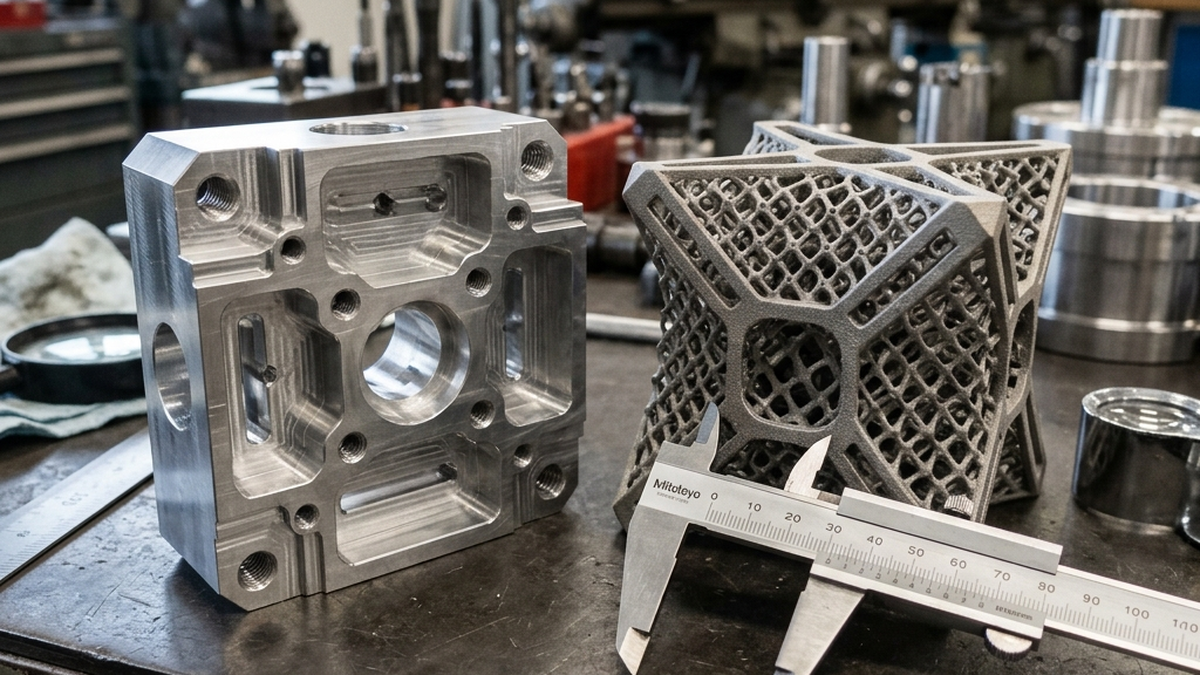
This is the one area where 3D printing has a clear, undeniable advantage. Additive manufacturing can build geometries that are physically impossible to machine.
3D Printing Required:
- Internal cooling channels that follow curved paths
- Lattice or honeycomb internal structures for weight reduction
- Fully enclosed internal cavities
- Topology-optimized organic shapes with no flat surfaces for fixturing
CNC Machining Handles Fine:
- External pockets, slots and contours
- Through-holes and counterbores from any accessible direction
- Thin walls (down to 0.020" with care)
- Complex 3D surfaces (5-axis milling)
- Threads, press-fit holes and precision bores
Most prototype parts fall into the "CNC handles fine" category. Internal channels and lattice structures are the main exceptions and those are typically found in aerospace or thermal management applications. If your part has standard features -- holes, pockets, fillets, chamfers, flat surfaces -- CNC machining will produce it faster, cheaper and more accurately than 3D printing.
Real-World Scenarios
Scenario 1: Consumer Electronics Enclosure
Need: 2 prototypes to check fit with PCB and display. Tolerances ±0.015". No structural loads. Final production: injection molded ABS.
Answer: 3D print (SLA). Smooth surfaces for visual evaluation, adequate tolerances, cheap and fast. No benefit to CNC machining here because the production part will be injection molded anyway.
Scenario 2: Aerospace Bracket
Need: 3 prototypes for vibration testing. Material must be 7075-T6 aluminum. Tolerances ±0.002" on mounting holes. Production part: CNC machined.
Answer: CNC machine. Material requirement, tight tolerances and functional testing all point to CNC. A 3D printed version would not survive the vibration test and the tolerance data would be meaningless.
Scenario 3: Heat Exchanger with Internal Channels
Need: 1 prototype with complex internal cooling channels that follow curved paths. Material: 316L stainless steel.
Answer: 3D print (DMLS). The internal channels cannot be machined. DMLS is the only option. Expect to CNC finish-machine the mounting surfaces and sealing faces after printing for dimensional accuracy.
Scenario 4: Robotic Gripper Fingers
Need: 10 identical parts in Delrin for integration testing. Tolerances ±0.003" on bearing surfaces.
Answer: CNC machine. Delrin is not available for 3D printing. The tolerance requirement rules out FDM/SLS. At 10 parts, CNC setup cost is amortized to under $20 per part.
Quick Cost Comparison
| Part Type | 3D Print Cost | CNC Cost | Winner |
|---|---|---|---|
| Small plastic form check (1 pc) | $15-40 | $100-200 | 3D printing |
| Aluminum bracket (1 pc) | $300-800 (DMLS) | $75-250 | CNC machining |
| Stainless steel fitting (1 pc) | $500-1,500 (DMLS) | $100-400 | CNC machining |
| Plastic housing (10 pcs) | $200-500 | $150-400 | CNC machining |
| Complex geometry with internal channels | $200-2,000 | Not possible | 3D printing |
The pattern is clear: 3D printing wins on cost for simple plastic parts in small quantities and for impossible-to-machine geometries. CNC machining wins for metal parts, tight tolerances, larger quantities and functional prototypes. For a more detailed breakdown, see our complete comparison guide or explore our full rapid prototyping services.
Frequently Asked Questions
Should I 3D print or CNC machine my prototype?
It depends on what you need from the prototype. If you need a quick form check and tolerances are loose, 3D print it. If you need production-grade materials, tight tolerances, functional testing capability, or a surface finish better than 125 Ra, CNC machine it. The deciding factor is whether the prototype needs to perform like the final production part.
Can I use 3D printing for metal parts?
Yes, through DMLS or SLM, which fuse metal powder layer by layer. Available metals include stainless steel, titanium, aluminum and Inconel. However, metal 3D printing is expensive ($300-2,000+ per part), requires post-processing and produces different material properties than wrought metals. CNC machining is usually cheaper and faster for metal prototypes.
At what quantity does CNC become cheaper than 3D printing?
For plastic parts, CNC becomes competitive at 5-10 units. For metal parts, CNC is often cheaper even for a single part because raw metal stock costs far less than metal powder and machine rates are comparable. The crossover depends on part size and complexity.
Do 3D printed parts have the same strength as machined parts?
No. 3D printed parts are weaker between layers (anisotropic). A printed nylon part might have 60-80% of the strength of solid nylon. Metal prints can approach wrought properties after heat treatment, but internal porosity and residual stress reduce fatigue life. CNC machined parts have full published material properties.
What surface finish can I expect from each process?
FDM: 200-500 Ra with visible layers. SLA: 50-100 Ra. SLS: 150-300 Ra with grainy texture. CNC milling: 63-125 Ra as-machined. CNC turning: 32-63 Ra. CNC parts are smoother and more consistent without layer artifacts.