
Satellite Optical Bench Bracket — 6061-T6 Aluminum
A space hardware startup building a small-sat Earth observation payload needed an optical bench bracket that aligns two mirrors and a detector. Any distortion shifts the optical path and degrades image resolution — flatness had to hold within 0.0003″ across a 10″ datum surface.
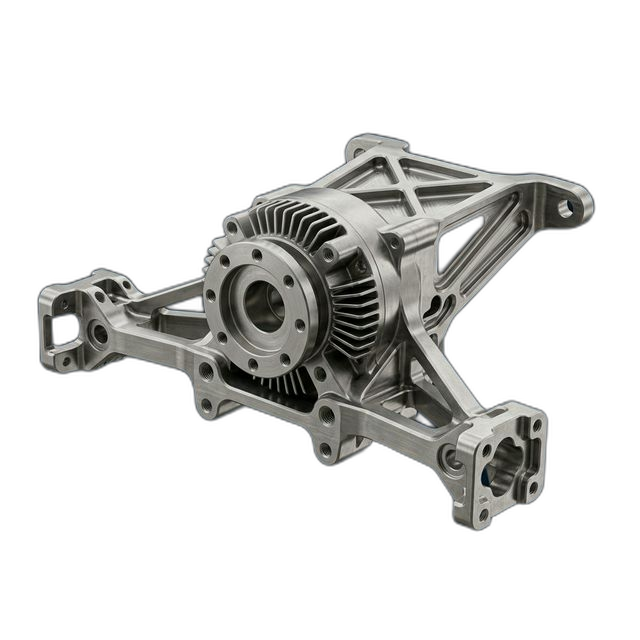
The Challenge
Flatness within 0.0003″ across a 10″ datum surface, plus three precision dowel pin bores at ±0.0002″ diameter and ±0.0005″ true position. The bracket cannot be clamped with mechanical jaws — clamping forces distort the part beyond flatness spec before the first cut is even made.
Our Approach
Vacuum fixture on a granite-verified sub-plate. Stress-relieved billet before machining. Roughed both sides, then let the part normalize before finish passes. Dowel pin bores reamed in the final operation referencing the freshly finished datum face.
The Result
0.0002″ flatness achieved — 33% better than the 0.0003″ spec. Optical alignment verified on first assembly with zero shimming required. All four brackets shipped in 7 days with full documentation.
Why This Part Is Hard to Machine
An optical bench bracket sounds straightforward — a flat plate with some holes. But the tolerances tell a different story. The 10″ datum surface must be flat within 0.0003″, which is less than the thickness of a human hair. Three dowel pin bores locate the mirror mounts with ±0.0002″ diameter tolerance and ±0.0005″ true position. If any bore is off, the optical path shifts and the satellite’s imaging resolution degrades.
The fundamental problem: you can’t clamp this part. Standard vise jaws or toe clamps introduce enough force to bow a 10″ aluminum plate by 0.001″ or more. Machine it while it’s bowed, release the clamps, and it springs back — now your “flat” surface is concave. The customer’s previous approach was to over-machine and hand-lap, but that doesn’t solve the bore position problem.
How We Solved It
We designed a vacuum fixturing strategy that holds the part with distributed atmospheric pressure instead of point loads. The key steps:
- Stress-relieved billet. Started with 6061-T6 aluminum plate (low outgassing grade per ASTM B209, suitable for vacuum environment). The billet was thermally stress-relieved before roughing to minimize residual stress that causes warping during machining.
- Rough both sides, then normalize. Roughed the top and bottom faces to within 0.015″ of final dimension, removing the bulk of the material symmetrically. Then removed the part from the machine and let it sit for 24 hours so any remaining internal stresses could equalize naturally.
- Vacuum fixture on granite-verified sub-plate. For finish passes, the part was held on a custom vacuum fixture. The sub-plate itself was verified flat on a granite surface plate before use. This ensures the reference surface under the part is true — vacuum simply holds the bracket against it without distortion.
- Dowel pin bores last. The three dowel pin bores were reamed in the final operation, referencing the freshly finished datum face. This guarantees bore position is measured from the actual finished surface, not a pre-machined reference that might shift during finishing.
Surface Finish and Post-Processing
The bracket received Alodine (chromate conversion coating per MIL-DTL-5541) — specifically a low-outgassing-compatible formulation suitable for vacuum service. Alodine adds negligible thickness (typically under 0.0001″), so it doesn’t affect the critical flatness or bore dimensions. The coating provides corrosion protection during ground handling and integration without contributing to molecular contamination in orbit.
What the Customer Said
“We were hand-lapping brackets at our previous vendor and still couldn’t hit the flatness spec consistently. RivCut nailed it on the first try with the vacuum fixture approach. Optical alignment checked out on first assembly — no shimming, no rework. We’re using them for the flight mirror mounts next.”
By the Numbers
Upload Your CAD File
Get instant AI pricing, a free DFM review, and full documentation on every order.
100% Made in USA · Never brokered · Ships anywhere in the US