
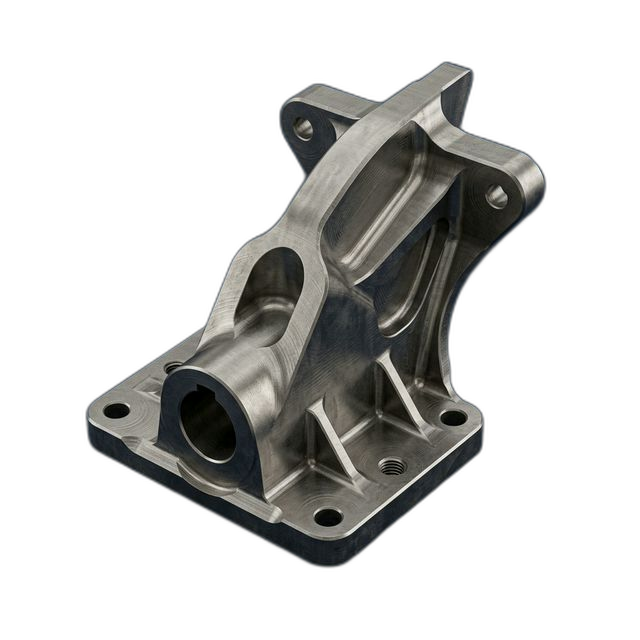
Night Vision Goggle Housing — 6061-T6 Aluminum
An optics integrator building next-gen night vision systems for a SOCOM program needed housings for their image intensifier tube and optical relay assembly. The housing positions two precision lenses and the intensifier tube — any misalignment degrades image quality and causes soldier eye strain during extended operations.
The Challenge
Three lens seat bores on different planes must be coaxial within 0.0003″ to maintain the optical centerline through the intensifier tube. Housing weight cannot exceed 95 grams for head-mounted use. Internal light baffle fins (0.030″ thick) prevent stray light from washing out the intensified image — and they’re fragile enough to deflect during machining.
Our Approach
5-axis milling to machine all bore seats from the same setup and datum, eliminating re-fixturing error between bore planes. Custom Delrin plug inserts supported the thin baffle fins during machining. Final weight: 91 grams. Bore coaxiality verified with optical pin gauge and CMM.
The Result
0.0002″ coaxiality achieved — better than the 0.0003″ callout. All 8 housings passed optical bench alignment testing. Final weight at 91 grams, 4 grams under the 95-gram target. Hard anodize Type III per MIL-A-8625 applied in matte black for light absorption.
Why Optical Alignment Drives Every Decision
Night vision goggle housings aren’t just enclosures — they’re optical benches. The housing establishes the spatial relationship between two relay lenses and the image intensifier tube. If those three elements aren’t coaxial, the optical path bends, the image shifts on the phosphor screen, and the operator sees a degraded field of view with uneven illumination. Over a 12-hour mission, that misalignment translates directly to eye strain and reduced situational awareness.
The drawing specified 0.0003″ coaxiality across three bore seats that sit on different planes within the housing. That’s a demanding callout on a single-plane part. When the bores are on different planes — stepped depths inside a pocket geometry — maintaining coaxiality requires that every bore is machined from the same datum in the same setup. Any re-fixturing between bore operations introduces enough angular error to blow the coaxiality budget.
On top of the optical requirements, the housing had a hard weight limit: 95 grams maximum. This is a head-mounted device that soldiers wear for hours. Every gram adds neck fatigue. The customer’s previous vendor had delivered housings at 102 grams, which forced a redesign with thinner walls and the addition of internal light baffle fins that doubled as structural ribs. The result was a part that’s lighter but significantly harder to machine.
Machining Strategy: One Setup, Three Coaxial Bores
We ran this part on our 5-axis mill and built the process around preserving coaxiality across all three bore seats:
- Single-setup 5-axis approach. All three bore seats were machined from one fixture position. The 5-axis capability let us access bore seats on different planes without re-clamping. The machine established a single coordinate system from the fixture datum, and every bore was referenced to that system. No re-fixturing, no re-indicating, no accumulated angular error.
- Delrin plug inserts for baffle support. The internal light baffle fins are 0.030″ thick aluminum — thin enough that cutting forces from adjacent operations would deflect them. We machined custom Delrin plug inserts that fit into the baffle cavities and supported the fins from both sides during bore finishing. The Delrin is soft enough not to mar the anodize-ready surfaces but rigid enough to prevent fin deflection during cutting.
- Weight-optimized roughing. We programmed adaptive roughing toolpaths that removed material in thin, consistent chips to avoid shock-loading the thin walls. The part was weighed after roughing to confirm we were on track for the 95-gram target. Final finish passes were calibrated to remove exactly the programmed amount — no extra material left behind that would push the housing over weight.
- Optical pin gauge and CMM verification. After machining, we inserted precision optical pin gauges into all three bore seats and measured the pin-to-pin alignment on the CMM. This gave us a direct measurement of the actual optical centerline deviation, not just individual bore position. The result: 0.0002″ coaxiality across all three bores.
Material: 6061-T6 Aluminum
The customer selected 6061-T6 for two reasons: weight and anodize quality. At 0.098 lb/in³, it’s light enough for a head-mounted device, and 6061 produces a consistent, uniform hard anodize layer — critical because the anodize serves a functional purpose here, not just cosmetic. The matte black Type III anodize absorbs stray light inside the housing that would otherwise bounce off internal surfaces and wash out the intensified image.
We sourced DFARS-compliant 6061-T6 plate with full material certification. Incoming hardness was verified at 95 HRB, consistent with T6 temper. The material was stress-relieved before machining to minimize distortion on the thin-walled sections during the aggressive material removal required to hit the 91-gram weight target.
Hard Anodize: MIL-A-8625 Type III
All 8 housings received Type III hard anodize per MIL-A-8625 in matte black. The hard anodize layer adds approximately 0.001″ per surface — half grows into the substrate, half grows outward. We accounted for this dimensional change on all bore seat diameters so that post-anodize dimensions were on-print. The matte black finish provides the light absorption characteristics required for the optical path, and the hardness of the Type III layer (60+ HRC equivalent) protects the bore seats from wear during lens installation and service.
ITAR-Aware Handling
This project involved defense-controlled technical data for a SOCOM night vision program. RivCut’s ITAR registration is in progress, and we handled all drawings, CAD files, and process documentation in accordance with ITAR access control requirements. Files were stored on secured systems with access limited to U.S. persons only. No technical data was shared outside the facility.
By the Numbers
Upload Your CAD File
Get instant AI pricing, a free DFM review, and full documentation on every order.
100% Made in USA · Never brokered · Ships anywhere in the US