
Laptop Hinge Prototype — 17-4 PH Stainless Steel
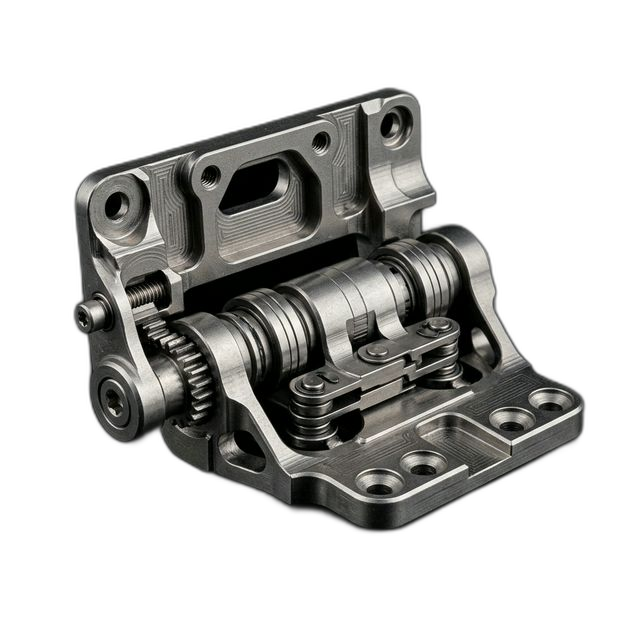
A consumer laptop maker developing an ultra-thin laptop needed functional hinge prototypes for open/close cycle testing and feel evaluation. The hinge must produce consistent torque across 20,000+ cycles — too light and the screen flops, too heavy and it feels cheap. Bore-to-shaft clearance controls everything.
The Challenge
Hinge barrel bore ±0.0003" for interference fit with the friction washer stack. Even 0.0005" variation in bore-to-shaft clearance changes the torque feel noticeably. Hinge arms are 1.8mm thick with compound bends machined from solid — not bent sheet. Weight target: under 18 grams per hinge.
Our Approach
Bore finished with micro boring bar — single pass, zero backlash compensation for roundness. Arms machined with 1mm endmill in climb-only direction to prevent deflection on thin sections. Made 5 test hinges at incremental bore offsets so the customer could select their preferred torque feel.
The Result
Customer selected +0.0001" interference based on feel testing. Cycle-tested to 25,000 opens/closes with less than 5% torque decay. Design frozen for mass production tooling.
Why This Part Is Hard to Machine
A laptop hinge looks small and simple, but it’s one of the most tolerance-critical parts in a consumer product. The hinge barrel bore controls the interference fit with a friction washer stack — that interference is what creates the torque you feel when opening and closing the lid. At ±0.0003", we’re working in a window where a half-thousandth of an inch either way changes the user experience.
The material makes it harder. 17-4 PH stainless steel in Condition H900 is heat-treated to 40+ HRC — great for wear resistance and spring properties, but it’s abrasive on tooling and generates significant cutting forces. The hinge arms are just 1.8mm thick and feature compound bends machined from solid billet (not bent sheet metal). At that wall thickness in hardened stainless, tool deflection and part deflection fight you at every pass.
Then there’s the weight constraint. The customer had an 18-gram budget per hinge. Every feature — the barrel, the arms, the mounting tabs — had to be optimized for minimum material while maintaining the rigidity to deliver consistent torque for 20,000+ cycles.
How We Solved It
We ran a free DFM review the day the STEP file came in and proposed a machining strategy tailored to the torque-critical bore and thin-wall geometry:
- Micro boring bar for bore finishing. We finished the hinge barrel bore with a micro boring bar in a single pass with zero backlash compensation. This eliminates the spring-back that multi-pass boring introduces in hardened stainless, delivering roundness within 0.0001". The bore surface finish was held under 8 Ra for consistent friction washer contact.
- Climb-only milling on thin arms. The 1.8mm hinge arms were machined with a 1mm endmill using climb-only cutting direction. Conventional milling would push the thin walls away from the cutter, causing deflection and dimensional error. Climb milling pulls the tool into the material, keeping cutting forces predictable and the wall thickness consistent.
- Five bore-size variants for torque selection. Instead of making all 20 hinges at nominal bore, we made 5 test hinges at bore diameters of nominal, +0.0001", +0.0002", −0.0001", and −0.0002". The customer assembled each with their washer stack and selected the torque feel they preferred before we machined the production batch.
Surface Finish and Post-Processing
The external surfaces were bead blasted for a uniform matte texture consistent with the laptop’s industrial design language. The hinges then went out for PVD coating (customer-furnished process) to match the laptop’s color scheme. We held bore dimensions to account for the PVD coating thickness on non-masked surfaces.
The barrel bore and friction contact surfaces were masked during bead blast and left as-machined to preserve the precise surface finish that the torque specification depends on.
What the Customer Said
“The bore-size variant idea was brilliant — we’d been going back and forth with our previous vendor trying to hit the right torque feel, and RivCut just gave us five options to pick from. We selected +0.0001" interference and the torque held through 25,000 cycles. Design frozen, tooling ordered. Exactly what we needed.”
By the Numbers
Upload Your CAD File
Get instant AI pricing, a free DFM review, and full documentation on every order.
No setup fees between iterations · Free DFM review · Ships anywhere in the US