
Wearable Health Monitor Housing — Delrin (Acetal)
A wearable tech startup building a continuous glucose monitor needed housings for their clinical trial units. The housing snaps onto a skin-adhesive patch and must be comfortable, lightweight, and dimensionally precise for the sensor/PCB assembly to fit without gaps.
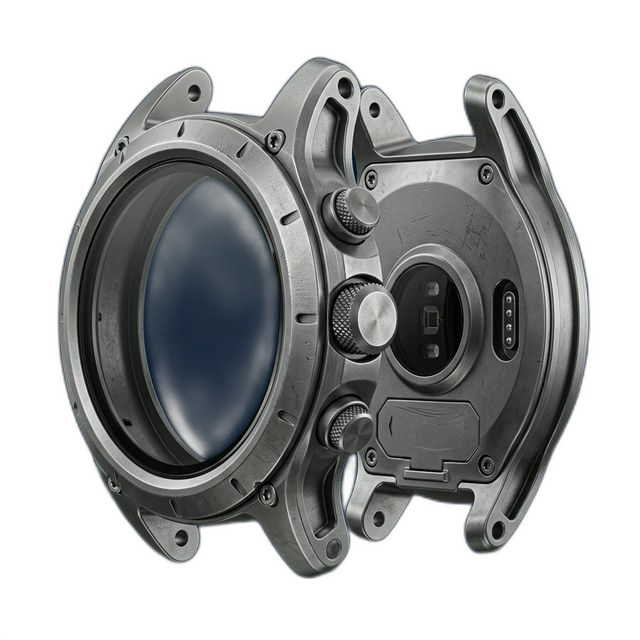
The Challenge
The housing has a snap-fit latch with 0.004" interference fit — too tight and it won’t snap on, too loose and it falls off during patient movement. Internal cavity must locate the sensor PCB with ±0.003" accuracy for optical sensor window alignment. The part is tiny (32mm × 22mm × 8mm), making fixturing the primary challenge.
Our Approach
Custom vacuum fixture with locating pins for repeatable positioning. Snap-fit features machined with a 0.030" endmill in a single pass to prevent step marks. Made 3 test parts at nominal, +0.001", and −0.001" interference so the customer could test snap force before committing to the full run.
The Result
V2 snap force was perfect based on the test parts. V4 was the final clinical trial version — 50 units produced for the trial. Zero housing-related failures during the 90-day clinical trial.
Why This Part Is Hard to Machine
Wearable device housings are deceptively difficult. The part itself is small — 32mm × 22mm × 8mm — which means you can’t clamp it in a standard vise without distorting the thin walls. The snap-fit latch is the critical feature: a 0.004" interference fit with ±0.001" tolerance. That’s a total window of just 0.002" between “too tight to snap on” and “falls off the patient.”
The internal cavity adds another layer of complexity. The optical sensor must look through a window in the housing, and if the PCB isn’t located to ±0.003", the sensor’s field of view shifts and you get bad readings. For a medical device in clinical trials, bad readings aren’t just inconvenient — they can invalidate the entire study.
Delrin is a great material choice for skin-contact wearables (lightweight, FDA-grade, dimensionally stable), but it has its own machining quirks. It’s springy — thin features tend to deflect away from the cutter and spring back, so the finished dimension ends up oversized. You have to compensate for that in your toolpath, and the compensation amount changes with wall thickness.
How We Solved It
We started with a free DFM review and immediately flagged the snap-fit tolerance as the highest-risk feature. Here’s the strategy we used:
- Custom vacuum fixture. We designed a vacuum fixture with locating pins that positions the small Delrin blank repeatably to within 0.001". The vacuum holds the part without clamping forces, so there’s no distortion of the thin walls. Same fixture worked for all four design iterations — we just updated the CNC program.
- Single-pass snap-fit machining. We machined the snap-fit latch features with a 0.030" endmill in one continuous pass. Multiple passes create tiny step marks at each Z-level that act as stress risers and change the effective interference. A single pass gives a smooth, consistent surface that snaps cleanly.
- Three-part interference test. Before running the first full batch, we made 3 test parts at nominal (0.004"), +0.001" (0.005"), and −0.001" (0.003") interference. The customer tested snap force on all three and confirmed that nominal was the right target. This avoided scrapping a full batch if the interference was off.
- No setup fees between iterations. The startup went through 4 design iterations in 3 weeks. Because the vacuum fixture was reusable and we keep programs on file, there was zero setup cost between versions. They only paid for material and machine time on each run.
Iteration History
Hardware startups don’t get it right on the first try — and they shouldn’t have to. Here’s how the design evolved:
- V1: Initial design. Snap fit worked but sensor window was 0.3mm off-center. 10 pieces.
- V2: Snap force dialed in using test-part data. Sensor window corrected. 10 pieces.
- V3: Adjusted sensor window by 0.5mm based on optical testing feedback. 10 pieces.
- V4: Final clinical trial version. 50 units produced for the 90-day trial. Zero housing-related failures.
Surface Finish
The housing sits directly against the patient’s skin via an adhesive patch, so surface finish matters for comfort. We vapor polished all external surfaces to create a smooth, glossy finish that won’t irritate skin during extended wear. Vapor polishing also closes micro-pores on the Delrin surface, which makes the housing easier to clean between uses — important for a medical device.
What the Customer Said
“Most shops wanted us to commit to 500 pieces minimum and charged setup fees every time we changed the design. RivCut made 10 pieces at a time, iterated with us four times in three weeks, and never charged a setup fee. The V4 housing ran through our entire clinical trial without a single failure. They get how startups work.”
By the Numbers
Upload Your CAD File
Get instant AI pricing, a free DFM review, and full documentation on every order.
No setup fees between iterations · Free DFM review · Ships anywhere in the US