
Hydraulic Valve Body — Hastelloy C-276 for Chemical Processing
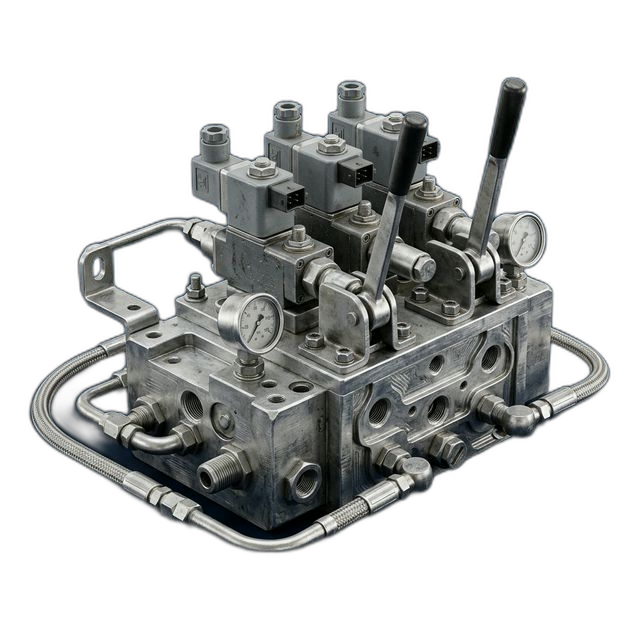
A chemical processing equipment manufacturer needed a custom hydraulic valve body machined from Hastelloy C-276 for a system handling hydrochloric acid at elevated temperatures. Standard stainless steel valves were corroding within months. They needed one of the most corrosion-resistant — and hardest to machine — alloys available.
The Challenge
The customer’s standard 316L stainless steel valve bodies were corroding after just three months in a hydrochloric acid processing line. They needed Hastelloy C-276 — an alloy that resists HCl, but work-hardens aggressively, generates extreme cutting heat, and destroys tooling. The internal spool bore required ±0.0005″ to seal properly, and cross-drilled passages had to be completely burr-free.
Our Approach
We roughed with ceramic inserts at low speed and high feed to stay ahead of the work-hardening zone. Finished the bore with a single-pass carbide reamer to hit ±0.0003″ and 12 Ra. Used thermal energy method (TEM) deburring to remove internal burrs at cross-hole intersections without affecting surface finish. CMM verified every critical dimension.
The Result
All 3 valve bodies passed pressure testing at 3,000 PSI. Installed in the customer’s acid processing line, zero corrosion after 6 months — where previous stainless valves failed at 3 months. Customer now orders quarterly replacements as standard maintenance inventory.
Why Hastelloy C-276 Is a Nightmare to Machine
If you’ve never cut Hastelloy, here’s the short version: it behaves like Inconel’s meaner cousin. The nickel-molybdenum-chromium matrix work-hardens almost instantly — if your tool dwells or rubs, the surface beneath it gets harder than the tool itself. It’s abrasive on carbide, generates extreme heat at the cutting edge, and produces long, stringy chips that love to wrap around your tooling.
Most shops avoid Hastelloy entirely, or they machine it like stainless and burn through inserts every few minutes. The key is understanding that the work-hardening zone is only about 0.003–0.005″ deep. If your depth of cut stays below that zone, you’re cutting into material that’s already been hardened by the previous pass. That’s a death spiral for your tool. You need to stay aggressive — deeper cuts, positive rake geometry, and constant feed engagement.
The Spool Bore: Where the Tolerance Lives
A hydraulic valve body is only as good as its bore. The spool rides inside this bore with dynamic O-ring seals — if the bore is out of round, oversized, or has a poor surface finish, the valve either leaks or the spool binds. The callout was ±0.0005″ on a 0.750″ bore diameter, with a surface finish requirement of ≤16 Ra.
We roughed the bore with a carbide boring bar, leaving 0.008″ of stock for the finish pass. Then we ran a single-pass carbide reamer at 120 SFM with through-coolant — the reamer’s geometry is ground for a specific stock removal, so you get one shot at it. Going too fast generates heat and glazes the bore. Going too slow lets the material work-harden ahead of the reamer. We dialed it in on a test piece first, then ran the production parts. Final bore measured ±0.0003″ with a 12 Ra finish — comfortably inside the ±0.0005″ and 16 Ra callouts.
Cross-Drilled Passages and TEM Deburring
Hydraulic valve bodies have intersecting passages — oil ports that cross-drill into the main spool bore at various angles. When a drill breaks through into an existing bore, it leaves a burr at the intersection. In most materials you can chase the burr with a deburring tool or a ball-end mill. In Hastelloy, those burrs are rock-hard and practically welded to the parent material.
Manual deburring is risky here — you can’t see the burrs inside the bore without a borescope, and any aggressive tool work risks damaging the bore finish you just spent an hour perfecting. We used thermal energy method (TEM) deburring instead. TEM works by introducing a combustible gas mixture into the part’s internal cavities, then igniting it in a controlled chamber. The resulting thermal pulse reaches approximately 3,000°C for a few milliseconds — long enough to oxidize thin burrs (which have high surface-area-to-mass ratio) but too brief to affect the bulk material or the bore surface finish.
After TEM, we borescoped every cross-hole intersection and documented the results with photographs. All passages were clean and burr-free.
Why the Customer Switched to Hastelloy
The economics are straightforward. A 316L stainless valve body costs less to machine but fails every 3 months in concentrated HCl service. Each failure means a line shutdown, valve replacement, and re-qualification. The Hastelloy C-276 valve body costs roughly 4× more to machine, but the customer’s first set showed zero degradation at 6 months. They calculated a break-even at 9 months and a 60% cost reduction over 2 years by switching to Hastelloy. The quarterly reorder they set up is for preventive replacement, not because the valves are failing.
Documentation and Traceability
Chemical processing applications require full material traceability. We shipped each valve body with a material certification to ASTM B575 / UNS N10276, CMM inspection data on the spool bore and port face flatness, borescope photographs of internal passages, and a Certificate of Conformance. The customer’s quality team approved all three parts on first submission.
By the Numbers
Upload Your CAD File
Get instant AI pricing, a free DFM review, and full documentation on every order.
100% Made in USA · Never brokered · Ships anywhere in the US