
Pressure Vessel Flange — Inconel 625
A chemical processing company building a reactor vessel for a high-temperature, high-pressure corrosive process — nitric acid at 500°F and 2,000 PSI — needed Inconel 625 flanges machined to ASME B16.5 specifications. Standard stainless steel couldn’t survive the combined thermal and chemical attack. The RTJ groove dimensions are critical for metal-to-metal sealing at these extreme conditions.
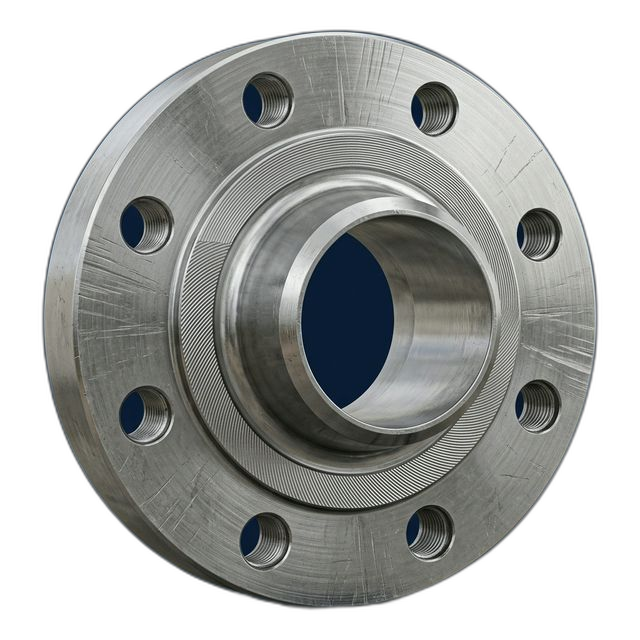
The Challenge
ASME B16.5 Class 600 flange (12″ NPS) with RTJ (Ring Type Joint) groove. RTJ groove width ±0.002″, depth ±0.001″, surface finish ≤63 Ra per ASME specification. Inconel 625 is even more difficult to machine than 718 — higher molybdenum content makes it stickier and more abrasive. Bolt circle ±0.005″ on 16 bolt holes.
Our Approach
Rough-turned with ceramic inserts at reduced speed using aggressive chip thinning to prevent work-hardening. RTJ groove finished with a form tool ground to the exact ASME groove profile — single-pass to prevent step marks on the sealing surface. Face finished to ≤32 Ra. Bolt holes drilled using RTJ groove centerline as datum reference.
The Result
All 4 flanges passed hydrostatic test at 3,000 PSI (1.5× working pressure). RTJ groove finish measured 28 Ra — better than the 63 Ra spec. Zero leaks with Inconel 625 ring gaskets. The vessel was commissioned and is operating without issues in nitric acid service.
Why Inconel 625 for Nitric Acid Service
Nitric acid at elevated temperatures is one of the most aggressive chemical environments for metallic components. Standard 316L stainless steel, which handles many acids well, suffers from intergranular corrosion in hot concentrated nitric acid. Even specialized stainless grades like 304L lose material at unacceptable rates above 400°F.
Inconel 625 (UNS N06625) is a nickel-chromium-molybdenum alloy specifically designed for extreme corrosive and high-temperature environments. Its high chromium content (20–23%) provides the oxidation resistance needed for nitric acid, while the molybdenum (8–10%) handles reducing conditions and pitting. At 500°F and 2,000 PSI, it’s one of the few alloys that can maintain both its mechanical properties and corrosion resistance simultaneously.
The RTJ Groove: Metal-to-Metal Sealing
At 2,000 PSI and 500°F, you don’t use a rubber gasket. You use a Ring Type Joint (RTJ) — a solid metal ring (in this case, also Inconel 625) that sits in a precision-machined groove on each flange face. When the bolts are tightened, the ring deforms slightly into the groove, creating a metal-to-metal seal. The groove geometry is defined by ASME B16.5 and API 6A down to the thousandths of an inch.
The critical dimensions are the groove width (±0.002″), groove depth (±0.001″), and the groove surface finish. If the groove is too wide, the ring doesn’t develop enough contact pressure. Too narrow and the ring won’t seat. Too rough and the surface asperities create leak paths that the ring can’t seal against. The ASME specification calls for ≤63 Ra, but tighter is better — every improvement in surface finish reduces the probability of a leak path.
Machining Inconel 625: Worse Than 718
If you’ve machined Inconel 718, you know it’s difficult. Inconel 625 is worse. The higher molybdenum content (8–10% versus 3% in 718) makes the material stickier and more prone to built-up edge on the cutting tool. The chips tend to weld themselves to the insert, which changes the effective cutting geometry and destroys the surface finish within seconds.
We roughed the flange profiles using ceramic inserts at reduced cutting speeds. Ceramic inserts can handle the extreme heat generated by Inconel better than carbide, but they’re brittle — you need rigid setups and consistent chip loads. We used aggressive chip thinning (high feed rate with shallow depth of cut) to keep the material from work-hardening ahead of the tool. Each roughing insert lasted about 15 minutes of cutting time, which is actually good for Inconel 625.
Single-Pass RTJ Groove Finishing
The RTJ groove was the most critical operation on the entire flange. We used a form tool that was custom-ground to the exact ASME groove profile — the correct radii, angles, and depth, all in a single tool. The finish cut was made in a single pass, plunging the form tool to depth and feeding along the groove diameter without stopping or dwelling.
Why single-pass? Because any step or overlap in the groove surface creates a potential leak path. If you take two passes and they don’t blend perfectly, you have a microscopic ridge running circumferentially around the groove. The ring gasket might seal against it initially, but under thermal cycling (which this reactor sees daily during startup and shutdown), that ridge becomes a stress concentration point where the ring eventually fails to maintain contact pressure.
Our single-pass approach produced a groove finish of 28 Ra — significantly better than the 63 Ra specification. On a profilometer trace, the surface was uniformly smooth with no step marks, tool entry marks, or chatter.
Datum Strategy: RTJ Groove Drives Everything
The bolt circle on an ASME B16.5 flange must be concentric with the sealing surface — in this case, the RTJ groove. If the bolt holes are offset from the groove center, the bolts will load the ring gasket unevenly, and one side of the ring won’t develop enough contact pressure to seal. We established the RTJ groove centerline as the primary datum, then moved the flanges to the mill and used the groove to pick up the datum for the bolt hole pattern. All 16 bolt holes were within ±0.003″ of their nominal positions — comfortably inside the ±0.005″ specification.
Full Material Traceability
Pressure vessel components require complete material traceability per ASME and the customer’s own quality requirements. Each flange shipped with an MTR (Material Test Report) documenting the full chemistry and mechanical properties of the Inconel 625 forging per ASTM B564. The MTR traces back to the specific heat number of the nickel alloy melt. We also provided CMM data on the RTJ groove profile, face flatness, and bolt circle position, plus a Certificate of Conformance certifying all dimensions and material requirements were met.
By the Numbers
Upload Your CAD File
Get instant AI pricing, a free DFM review, and full documentation on every order.
100% Made in USA · Never brokered · Ships anywhere in the US