
Wearable Insulin Pump Housing — Implant-Grade PEEK-OPTIMA
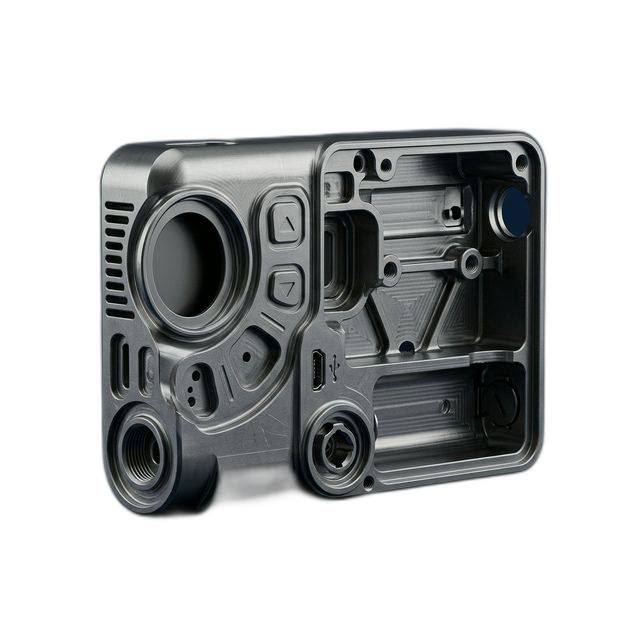
A MedTech startup building a tubeless insulin patch pump needed a housing that attaches directly to the patient’s skin — lightweight, biocompatible, and dimensionally stable across body temperature fluctuations. Five design iterations over four weeks to reach the clinical version.
The Challenge
Internal cavity must locate three sub-assemblies (insulin reservoir, micro-pump, wireless PCB) with ±0.002″ relative position. Skin-contact surface must be smooth (Ra < 16 μin) to prevent irritation during 3-day wear. Snap-fit battery door with 0.003″ interference fit. Total housing weight target: under 8 grams.
Our Approach
Vacuum fixture for the small part (38mm × 25mm × 12mm). All cutters new or resharpened to prevent PEEK smearing. Snap-fit features machined in single pass to avoid step marks. Test parts at nominal, +0.001″, and -0.001″ interference for customer to evaluate battery door snap force.
The Result
V3 snap force selected based on test parts. V5 was the final clinical version. 200 units produced for 90-day clinical trial. Zero housing-related adverse events reported.
Why a Wearable Pump Housing Is Harder Than It Looks
A tubeless insulin patch pump sits on the patient’s skin for three days at a time. That creates a set of requirements you don’t encounter with most medical device housings. The skin-contact surface must be smooth enough to avoid irritation over a 72-hour wear period — any tool mark, parting line, or surface imperfection that a patient can feel will cause discomfort and ultimately non-compliance. In diabetes management, device compliance is a clinical outcome.
PEEK-OPTIMA (Invibio’s implant-grade PEEK) was specified for its combination of biocompatibility per ISO 10993, excellent dimensional stability across the 32–37°C body temperature range, low moisture absorption (which prevents swelling on skin), and sterilizability. It’s also lightweight — critical when the entire pump must stay under 30 grams fully assembled, with the housing budget at 8 grams.
The snap-fit battery door is the feature that drove the most iteration. The interference fit controls the snap force — too loose and the door opens during patient activity, too tight and the patient can’t change the battery. At 0.003″ nominal interference, the difference between “satisfying click” and “can’t close without a tool” is about 0.002″. PEEK’s elastic modulus makes it suitable for snap-fit designs, but the dimensional window is narrow.
How We Solved It
Our DFM review and machining approach addressed the unique challenges of this wearable device:
- Vacuum fixturing for the small part. At 38mm × 25mm × 12mm, this part is too small for conventional clamping without risk of distortion. We machined a vacuum fixture with a custom pocket that holds the housing on its exterior surfaces via vacuum pull-down. This eliminated clamp marks on the skin-contact surface and provided uniform holding force across the part.
- Sharp tooling to prevent PEEK smearing. PEEK machines cleanly with sharp cutters but smears with dull ones. Smearing produces a poor surface finish that looks acceptable visually but feels rough to the touch — exactly the wrong outcome for a skin-contact device. We used new or freshly resharpened cutters for every iteration and tracked tool usage per part count.
- Single-pass snap-fit features. The snap-fit latch on the battery door was machined in a single continuous pass rather than multiple step-over passes. Step marks from multiple passes create stress concentration points in the snap-fit beam, reducing fatigue life. A single pass produces a consistent surface that distributes bending stress evenly across the beam during snap engagement.
- Interference fit test parts. For the snap-fit feature, we machined test parts at three interference values: nominal (0.003″), +0.001″ (0.004″), and -0.001″ (0.002″). This gave the customer’s human factors team physical samples to evaluate snap force with actual end users rather than relying solely on FEA predictions.
Five Iterations, Zero Setup Fees
The customer went through five design iterations over four weeks. Each iteration consisted of 15 pieces — enough for internal testing, human factors evaluation, and destructive testing. The changes between iterations were driven by user feedback:
V1 → V2: Increased wall thickness around the reservoir pocket after drop testing showed cracking. V2 → V3: Adjusted snap-fit interference based on test parts (selected 0.003″ nominal). V3 → V4: Added a seal groove for the skin-contact adhesive gasket. V4 → V5: Minor cosmetic radius changes on the exterior edges. V5 was the clinical version.
No setup fees between iterations. Same vacuum fixture (modified once for the V4 seal groove), same PEEK-OPTIMA material stock, same operator. Each iteration shipped within 3–5 days of receiving the revised STEP file.
Vapor Polish for Skin Contact
The skin-contact surface was vapor polished after machining to achieve Ra < 16 μin. Vapor polishing exposes the PEEK surface to a controlled solvent atmosphere that softens micro-peaks and produces a glass-smooth finish without removing significant material or altering critical dimensions. The result is a surface that patients described as “comfortable” and “unnoticeable” during wear testing.
From Prototype to Clinical Trial
After V5 was finalized, the customer ordered 200 production units for a 90-day clinical trial. We produced these on the same fixture and programs used for the prototypes, ensuring dimensional consistency between the trial units and the prototypes that had been validated in bench testing. The 200-unit lot shipped with full documentation: dimensional reports per piece, PEEK-OPTIMA material certification with biocompatibility data, Certificate of Conformance, and weight verification for each housing.
The 90-day clinical trial enrolled 50 patients. Zero housing-related adverse events were reported — no skin irritation, no battery door failures, no dimensional issues affecting pump function.
By the Numbers
“Five iterations in four weeks, no setup fees, same fixture and operator throughout. When you’re racing toward a clinical trial, that continuity is worth more than the parts themselves.”
Upload Your CAD File
Get instant AI pricing, a free DFM review, and full documentation on every order.
100% Made in USA · Never brokered · Ships anywhere in the US