
Actuator Gearbox Housing — Bridge Production from 10 to 500 Units
An automation company building industrial pick-and-place systems needed to scale their actuator gearbox housing from prototype quantities to 500-unit bridge production — maintaining ±0.001" on bearing bores and gear mesh center distance while cutting cycle time by 38%.
The Challenge
The customer’s prototype toolpath took 45 minutes per part — acceptable for 10 units, unsustainable for 500. They needed consistent ±0.001" on bearing bores and ±0.0005" on gear mesh center distance at volume, without retooling or sacrificing quality for speed.
Our Approach
Re-programmed toolpaths for production efficiency. Built a multi-part fixture (4 parts per setup instead of 1). Implemented SPC monitoring on critical bearing bores to catch drift before parts go out of spec. Dedicated fixture stays on the machine for recurring orders.
The Result
500 units shipped over 6 weeks with zero rejected parts. SPC showed Cpk of 1.67 on bearing bores — well above the 1.33 minimum. Cycle time dropped from 45 to 28 minutes, saving the customer 22% on unit cost versus prototype pricing.
The Prototype-to-Production Gap
Most machine shops can make 10 good parts. The hard part is making 500 good parts at a price that works. When this customer came to us, they had a working prototype toolpath — it produced dimensionally correct housings, but at 45 minutes per part. At that cycle time, 500 units would take over 375 hours of spindle time. The math didn’t work.
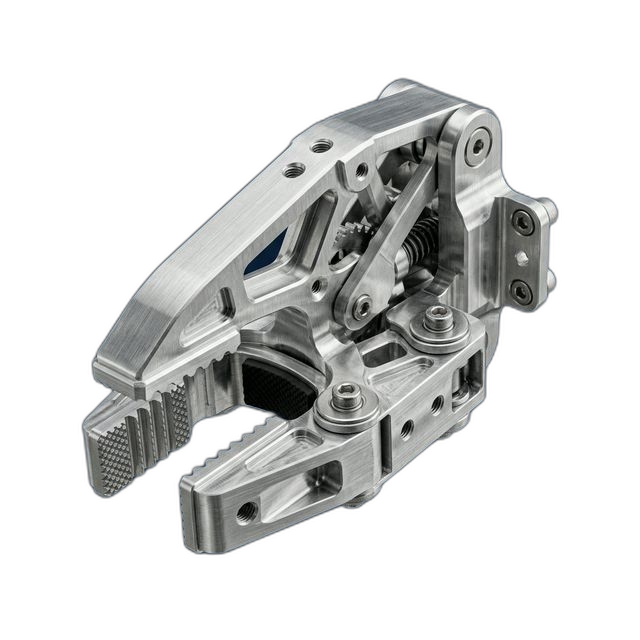
The gearbox housing is the structural backbone of their pick-and-place actuator. It contains two bearing bores that support the input and output shafts of a planetary gear reducer, plus a precision-ground gear mesh interface where the center distance between bores must be held to ±0.0005". If the center distance drifts, the gears bind or develop excessive backlash — either failure mode kills the actuator’s positional accuracy.
How We Cut Cycle Time by 38%
We didn’t compromise on tolerances to save time. Instead, we attacked cycle time from three angles:
- Toolpath optimization. The prototype program used conservative feeds and speeds appropriate for first articles. We re-programmed with production-tuned parameters — higher feed rates on non-critical surfaces, trochoidal milling on deep pockets to reduce tool engagement time, and optimized approach/retract paths to eliminate air cutting. This alone saved 8 minutes per part.
- Reduced tool changes. The prototype program used 14 tools. We consolidated to 9 by selecting tools that could serve multiple operations — a single endmill for both roughing and semi-finishing pockets, a combination drill/chamfer tool for bolt holes. Each tool change saved 12–15 seconds; over 500 parts, that adds up.
- Multi-part fixturing. We designed a fixture that holds 4 housings per setup. Load/unload time is amortized across 4 parts instead of 1. The fixture uses precision dowel pins for repeatable part location — no indicating required between parts. The fixture lives on the machine and is ready for the next order without any setup time.
SPC Monitoring for Production Consistency
Holding tolerance on part 1 is easy. Holding it on part 500 — after 230+ hours of cutting, tool wear, and thermal drift — requires process control. We implemented statistical process control (SPC) on the two critical bearing bores and the gear center distance.
Every 25th part gets pulled for CMM measurement. The bore diameters and center distance are plotted on X-bar and R charts. Control limits are set at ±2 sigma, which gives us early warning of drift well before parts approach the ±0.001" spec limit. When the charts showed the input bore trending 0.0002" toward the upper limit around part 200, we made a 0.0001" offset correction and the process re-centered immediately.
The final Cpk on bearing bores was 1.67 — meaning the process spread used only 60% of the available tolerance band. On gear center distance, Cpk was 1.45. Both exceed the 1.33 minimum that most quality systems require for production capability.
Hard Anodize for Wear Resistance
The bearing surfaces in the housing see constant rotational loading from the gear reducer. The customer specified Type III hard anodize (MIL-A-8625 Type III) on all bearing surfaces to provide a hard, wear-resistant layer. Hard anodize adds approximately 0.001" per surface, so we machined the bores 0.001" undersize to hit final dimension after coating. The anodize was included in our lead time — no separate coordination needed from the customer.
What the Customer Said
“We expected unit costs to drop when we went to volume, but a 22% reduction was beyond what we modeled. The SPC data gave our quality team confidence to skip incoming inspection after the first 50 units — that saved us even more time on our end. We’re already planning the next 500-unit release.”
By the Numbers
Upload Your CAD File
Get instant AI pricing, a free DFM review, and full documentation on every order.
100% Made in USA · Never brokered · Ships anywhere in the US