
Robot Arm Joint Assembly — Titanium 6Al-4V Harmonic Drive Housing
A robotics startup building collaborative robots for semiconductor wafer handling needed precision joint housings in titanium. The housing seats a harmonic drive reducer and encoder — coaxial bore alignment must be near-perfect for smooth rotation and zero backlash.
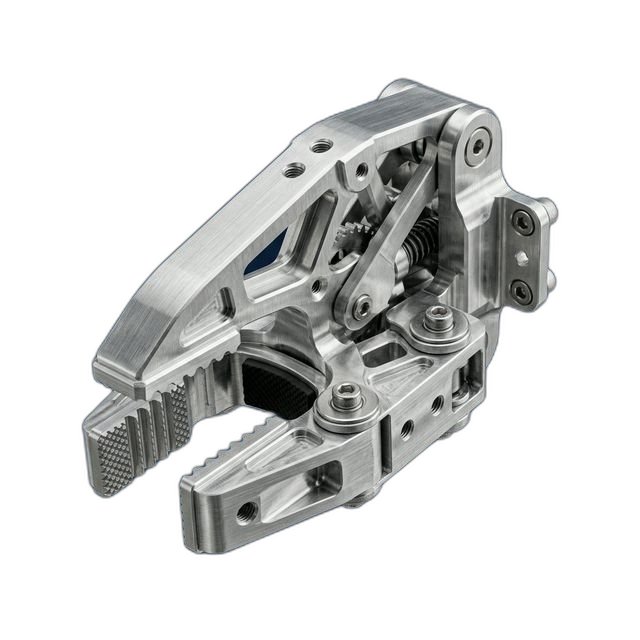
The Challenge
Two coaxial bores — motor side and output side — on opposite faces of each joint housing must be concentric within 0.0003" and perpendicular to the flange face within 0.0002". These tolerances exceed what most shops can hold on titanium 6Al-4V, which is prone to thermal growth during machining. The customer’s previous vendor delivered parts that always required shimming at assembly.
Our Approach
5-axis machining in a single setup to eliminate re-fixturing error. Both bores machined with the same boring bar in one operation. Flood coolant temperature controlled to ±2°F to minimize thermal growth in the titanium. In-process probing after roughing to verify bore location before finishing passes.
The Result
All 6 joints assembled with zero shimming required. Encoder runout measured at 0.0001" — half the tolerance budget. The customer moved all joint machining to RivCut for their next 3 cobot builds.
Why Titanium Joint Housings Are Difficult
A cobot joint housing looks like a flanged cylinder with two precision bores on opposite sides. Simple geometry, hard tolerances. The motor bore accepts a harmonic drive input shaft bearing, and the output bore seats the cross-roller bearing that supports the joint’s output flange. If those two bores aren’t concentric, the harmonic drive binds, encoder readings drift, and the robot loses positional repeatability.
Titanium 6Al-4V makes this harder. The material has low thermal conductivity — roughly one-sixth that of aluminum — so heat concentrates at the cutting zone instead of dissipating through the workpiece. During a 20-minute boring operation, the part can grow 0.0002–0.0004" from thermal expansion alone. If you bore one side, flip the part, and bore the other side, the thermal state is different for each bore. That’s how concentricity errors happen.
Single-Setup Strategy
We eliminated the re-fixturing problem entirely by machining both bores in a single 5-axis setup. Here’s how:
- Single boring bar, both bores. The part is fixtured on its flange face. The spindle machines the motor bore from the top, then the B-axis rotates 180° to access the output bore from the opposite side — same tool, same thermal state, same coordinate system. No re-fixturing, no datum shift.
- Coolant temperature control. We ran flood coolant through a chiller held at ±2°F. On a standard machine with uncontrolled coolant, titanium boring operations can see coolant temperature drift 8–10°F over the course of a shift. That thermal drift translates directly to bore size variation.
- In-process probing. After roughing each bore to within 0.005" of final size, we probed the bore location and diameter. This gave us a thermal map of the part before finishing — we could compensate for any growth before taking the finish pass.
- Honing to final finish. After CNC boring to size, we honed the critical bearing bores to achieve Ra ≤8 microinch surface finish. The honing operation also corrected any minor out-of-roundness from the boring operation, ensuring proper bearing fit and smooth rotation under load.
Why Material Choice Matters for Cobots
The customer chose titanium 6Al-4V specifically for weight. A cobot arm has strict payload constraints — every gram of joint housing weight is a gram the robot can’t carry as payload. Titanium gives a 40% weight savings over steel at comparable strength, and unlike aluminum, it won’t creep under sustained bearing preload. For a joint that cycles millions of times in a semiconductor fab, that fatigue resistance matters.
The tradeoff is machinability. Titanium costs more to cut, requires specialized tooling, and punishes sloppy process control. But the weight and strength advantages are non-negotiable for a 6-axis cobot handling 300mm wafer cassettes.
What the Customer Said
“Our previous vendor’s joints always needed shims between the harmonic drive and the housing. Every shim adds a compliance that degrades positional accuracy. RivCut’s parts dropped in with zero shimming — our encoder runout was half what we budgeted. We’re scaling to 20 cobots next quarter and RivCut is our sole source for joint housings.”
By the Numbers
Upload Your CAD File
Get instant AI pricing, a free DFM review, and full documentation on every order.
100% Made in USA · Never brokered · Ships anywhere in the US