
Linear Actuator Body — 303 Stainless Steel for Semiconductor Wafer Handling
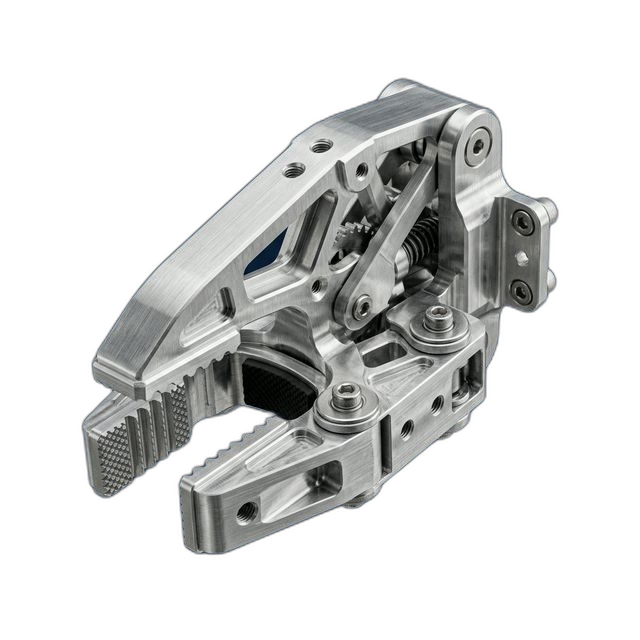
An industrial automation company building custom linear actuators for semiconductor wafer handling needed actuator bodies with grinding-level bore straightness and rail surface flatness — achieved entirely through CNC boring and milling, no grinding required.
The Challenge
The ball screw bore is 22mm diameter × 200mm long with straightness within 0.0005" over the full length. The rail mounting surface (200mm long) must be flat within 0.0003" and parallel to the bore centerline within 0.0005". These tolerances are typical of grinding operations, but the customer needed 8 bodies in 6 days — too fast for a grinding workflow.
Our Approach
Bored the ball screw bore in a single pass with a long-reach carbide boring bar. Monitored bore straightness with in-process probing at 4 stations along the bore. Rail surface finished with a climb-milling strategy using a fly-cutter for mirror-flat finish. Parallelism verified on CMM with bore axis constructed from 5-point measurements at each end.
The Result
Bore straightness measured 0.0003" — beating the 0.0005" spec. Stage positioning accuracy measured ±1 μm by the customer’s laser interferometer, meeting their specification without grinding. Electropolish finish met cleanroom compatibility requirements.
Grinding-Level Tolerances Without Grinding
In precision linear motion, the actuator body is the reference datum for everything. The ball screw rides in the bore, the linear rail bolts to the mounting surface, and the carriage moves along both. If the bore isn’t straight, the ball screw binds. If the rail surface isn’t flat, the carriage rocks. If the bore and rail aren’t parallel, the stage drifts laterally as it travels. For semiconductor wafer handling, where positioning accuracy is measured in microns, these relationships have to be near-perfect.
Most shops would send this part to a grinding house for the bore and rail surface. Grinding can achieve the tolerances, but it adds 2–3 weeks to the schedule and doubles the cost. The customer needed 8 bodies in 6 days. We had to achieve grinding-level results with CNC boring and milling alone.
How We Held 0.0003" Bore Straightness
A 200mm-long bore at 22mm diameter has an L/D ratio of about 9:1. At that ratio, a boring bar will deflect unless it’s stiff enough and the cutting forces are controlled. Here’s our approach:
- Long-reach carbide boring bar. We used a solid carbide boring bar with a damped shank to minimize chatter and deflection. The carbide shank is 3× stiffer than steel at the same diameter, which keeps the tool on-center throughout the bore length.
- In-process probing at 4 stations. After the roughing pass, we probed the bore diameter and position at 4 equally spaced stations along the 200mm length. This gave us a straightness profile before the finishing pass. If the rough bore showed more than 0.001" deviation, we could adjust the finish pass offset to compensate.
- Single-pass finishing. The finishing pass removed only 0.003" per side at a controlled feed rate. Light cuts mean low cutting forces, which mean less boring bar deflection. The bore came out at 0.0003" straightness — beating the 0.0005" spec.
- Fly-cutter rail surface. The rail mounting surface was finished with a single-point fly-cutter using a climb-milling strategy. A fly-cutter produces a surface that’s as flat as the machine’s axis motion — on our machines, that’s better than 0.0002" over 200mm. The resulting surface was mirror-flat with no visible cutter marks.
Why 303 Stainless for Wafer Handling
The customer chose 303 stainless steel for three reasons. First, it’s non-magnetic — critical when the actuator operates near a wafer stage where magnetic fields can interfere with lithography or inspection equipment. Second, it’s corrosion-resistant for cleanroom environments where humidity and chemical exposure are controlled but still present. Third, 303 is the free-machining grade of austenitic stainless — the added sulfur makes it cut cleanly, which helped us achieve the surface finishes needed for electropolishing.
After machining, the bodies were electropolished to cleanroom-compatible surface finish. Electropolishing removes the top 0.0002–0.0005" of material, smoothing micro-peaks and creating a passive oxide layer that resists particle generation — exactly what a semiconductor fab requires.
What the Customer Said
“We assumed we’d need to grind the bore and rail surface. RivCut hit 0.0003" straightness and flatness with CNC alone, which cut 2 weeks off our build schedule. Our laser interferometer confirmed ±1 micron positioning — identical to what we’d get from a ground body. We’re ordering 24 more bodies for our next platform.”
By the Numbers
Upload Your CAD File
Get instant AI pricing, a free DFM review, and full documentation on every order.
100% Made in USA · Never brokered · Ships anywhere in the US