
Mobile Robot Chassis Plate — 7075-T6 Aluminum with Weight-Optimized Pocketing
A field robotics startup building pipeline inspection robots needed a structural chassis plate that’s lightweight for battery life but stiff enough to maintain sensor alignment over rough terrain. The plate mounts drive motors, battery pack, compute module, and sensor suite — 16 precision bores can’t be off or motors bind and drain the battery.
The Challenge
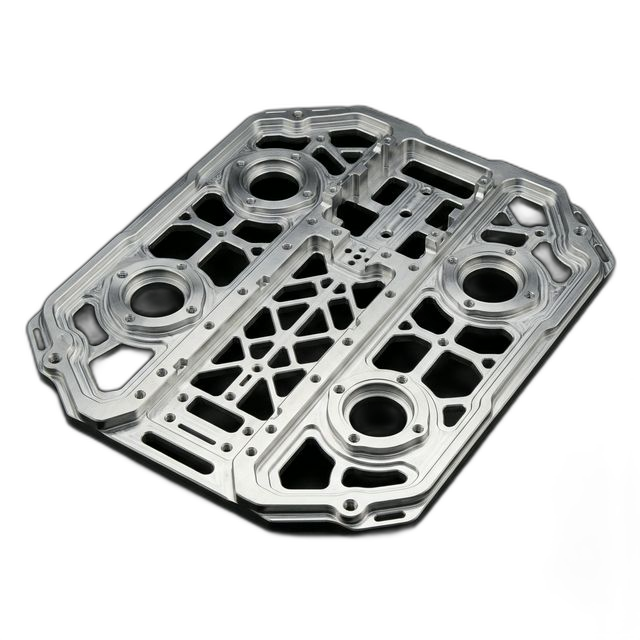
The plate is 18" × 12" × 0.375" with a complex pocket pattern that reduces weight 40% while maintaining stiffness. 16 precision motor/gearbox mounting bores must hold ±0.001" true position — if any bore is off, drive motors bind and draw excessive current, reducing battery life. The plate must be flat within 0.002" after pocketing — aggressive material removal from thin plates causes warping.
Our Approach
Started with stress-relieved 7075 plate. Roughed pockets from both sides (alternating) to equalize stress release. Left 0.010" floor stock, then flipped and finished in sequence to maintain flatness. Motor bores drilled in the final operation after all pocketing stress was released.
The Result
Flatness measured 0.0015" — 25% better than spec. Motor alignment confirmed with drive current draw matching design prediction within 3%. Robot operated 8+ hours on a single charge, exceeding the 6-hour spec by over 30%.
Why Thin-Plate Pocketing Warps Parts
When you machine deep pockets into a thin plate, you’re removing material that was holding the plate in its stress-equilibrium state. Every aluminum plate has residual stresses from rolling, heat treating, and stress relieving. Pocket one side aggressively and the plate bows toward that side — the remaining material on the opposite face is still compressed and pulls the plate into a curve. On an 18" × 12" plate at 0.375" thick, a naive pocketing strategy can produce 0.010–0.020" of bow. That’s an order of magnitude more than the 0.002" flatness spec.
The second problem is bore position. If you drill motor bores first and then pocket around them, the pocket stress release shifts the bores. Bore true position drifts and motors don’t line up with their gearboxes. Drilling bores last — after all stress-releasing material removal is done — is the key to holding position.
Alternating-Side Roughing Strategy
We managed the warping problem by equalizing material removal between sides:
- Stress-relieved 7075-T6 starting stock. We sourced plate that was stress-relieved after heat treatment. This reduces (but doesn’t eliminate) residual stress. Standard 7075-T6 plate from a service center can have 5–10 ksi residual stress; stress-relieved plate is typically under 3 ksi.
- Alternating-side roughing. We roughed pockets from Side A, flipped the plate, roughed from Side B, then repeated. Each pass removed the same volume from each side, keeping the stress release balanced. The plate stayed flat throughout roughing because neither side was ever significantly more machined than the other.
- 0.010" floor stock for finishing. We left 0.010" on all pocket floors during roughing. After all roughing was complete and the plate had released its stress, we took the finishing passes. The finish pass removes so little material that it doesn’t induce additional warping.
- Motor bores drilled last. All 16 motor/gearbox mounting bores were drilled and reamed in the final operation, after all pocketing was complete. This means the bores were placed in the plate’s final stress state — no subsequent machining to shift them. Final weight: 1.8 lbs, under the 2.0 lb target.
Why 7075-T6 for Field Robot Chassis
The customer evaluated 6061-T6 and 7075-T6. Both are aluminum, but 7075 has 40% higher yield strength and 30% higher stiffness. For a chassis that has to survive rough terrain — pipeline corridors with gravel, mud, and uneven surfaces — the higher strength means thinner walls and deeper pockets while maintaining the same safety factor. That translates to less weight for the same stiffness, which directly extends battery life.
The tradeoff is that 7075 is more prone to stress corrosion cracking, but Type III hard anodize solves that. The hard anodize also provides abrasion resistance for a chassis that scrapes over rocks and debris in the field.
What the Customer Said
“We prototyped our first chassis plates on a waterjet and hand-drilled the motor bores. Two of the four motors bound on the first robot — the bore positions were off by 0.005–0.008". RivCut’s plates dropped in perfectly. Motor current draw matched our simulation within 3%, which told us the bores were right. The 8-hour battery life was a huge deal for our field trials — our spec was 6 hours and we were worried about falling short.”
By the Numbers
Upload Your CAD File
Get instant AI pricing, a free DFM review, and full documentation on every order.
100% Made in USA · Never brokered · Ships anywhere in the US