
Landing Gear Torque Link — 4340 Steel, Heat Treated
A Tier 2 landing gear supplier needed prototype torque links for a new regional jet program. The torque link connects the upper and lower gear cylinders and must handle extreme shear and bending loads during landing impact — machined from 4340 steel heat treated to 260–280 ksi UTS.
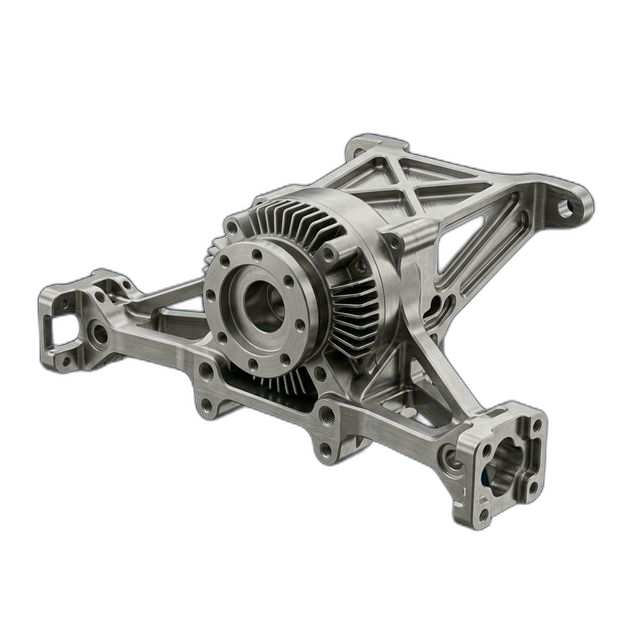
The Challenge
Pre-compensating for heat treat distortion. Each torque link has a clevis at each end with precision bores for pivot pins (±0.0005″ diameter, ±0.001″ true position). After heat treatment to 260–280 ksi, distortion shifts bore position by 0.003″–0.005″. Then you have to finish-bore steel at 52+ HRC.
Our Approach
Machined rough geometry with 0.010″ stock on bores. Sent for vacuum heat treat + temper to 260–280 ksi. Post-heat-treat: fixtured on hardened V-blocks referencing the OD, then finish-bored both clevis bores using carbide boring bars with CBN inserts rated for 60+ HRC.
The Result
All bores within ±0.0003″ after post-heat-treat finishing. Hardness verified at 52–54 HRC across all test points. The customer qualified all four parts for the flight test program.
Why This Part Is Hard to Machine
Landing gear torque links are deceptively simple looking — two clevis ends connected by a link body. But the combination of material, heat treatment, and tolerance requirements makes them one of the more demanding aerospace components to produce correctly.
The core problem is sequencing. You can’t finish-machine the bores before heat treatment because distortion will move them 0.003″–0.005″ out of position — well beyond the ±0.0005″ diameter and ±0.001″ true position callouts. But you also can’t easily machine 4340 after it’s been heat treated to 260–280 ksi (52–54 HRC). At that hardness, conventional carbide tooling won’t last through a single bore. The material is harder than many cutting tools.
There’s also a fixturing challenge. After heat treatment, the part surfaces aren’t perfectly true anymore. You need to re-establish datums on a distorted part, then bore precision holes from those new references. If your fixturing doesn’t account for the distortion, the bore-to-bore relationship — which is what actually matters for the pivot pin fit — will be wrong even if each individual bore measures correctly.
How We Solved It
We split the job into three distinct phases, with a clear handoff plan at each stage:
- Phase 1 — Rough machining with stock allowance. Machined the complete torque link geometry from 4340 billet in the annealed condition, leaving 0.010″ of stock on all bore diameters and faces. The OD profile, clevis geometry, and link body were machined to final dimension at this stage since they don’t carry the same positional criticality as the bores.
- Phase 2 — Vacuum heat treat and temper. Parts were sent to a qualified heat treat vendor for vacuum heat treat to prevent decarburization, followed by temper to achieve 260–280 ksi UTS (52–54 HRC). We ran CMM inspection both before and after heat treat to document exactly how much each bore shifted during the process.
- Phase 3 — Post-heat-treat finish boring. This is where the job is won or lost. We fixtured each torque link on hardened V-blocks, referencing the OD surfaces (which were machined to final dimension pre-heat-treat and provide a stable datum even after distortion). Both clevis bores were then finish-bored using carbide boring bars with CBN (cubic boron nitride) inserts rated for 60+ HRC. Single-pass finishing at controlled depth of cut — no spring passes, no rubbing. CBN cuts cleanly at these hardness levels, but only if chip load is maintained. Any rubbing burns the insert and ruins the surface finish.
Surface Finish and Post-Processing
The bore surfaces were finished to 16 Ra to ensure proper pivot pin fit. Cadmium plating per QQ-P-416 was specified by the customer and applied at their own qualified plating facility after receiving the finished parts. Cadmium provides excellent corrosion protection and acts as a lubricant on the pivot pin interface — both critical for landing gear components that see moisture, salt spray, and high-cycle articulation.
What the Customer Said
“Most shops quote 4–6 weeks on heat-treated 4340 landing gear components. RivCut had all four torque links in our hands in 12 days, including the heat treat cycle. The post-heat-treat bore data was better than what we typically see from our Tier 1 vendors. We qualified all four parts for the flight test program without any rework.”
By the Numbers
Upload Your CAD File
Get instant AI pricing, a free DFM review, and full documentation on every order.
100% Made in USA · Never brokered · Ships anywhere in the US