
Titanium Structural Bracket — DFM Review Saved 35%
A commercial aerospace customer submitted a Ti 6Al-4V wing rib mounting bracket with over-toleranced features across the board. RivCut’s DFM review identified three tolerance and geometry changes that cut machining cost by 35% — with zero impact on part function — and delivered 20 pieces in 6 business days.
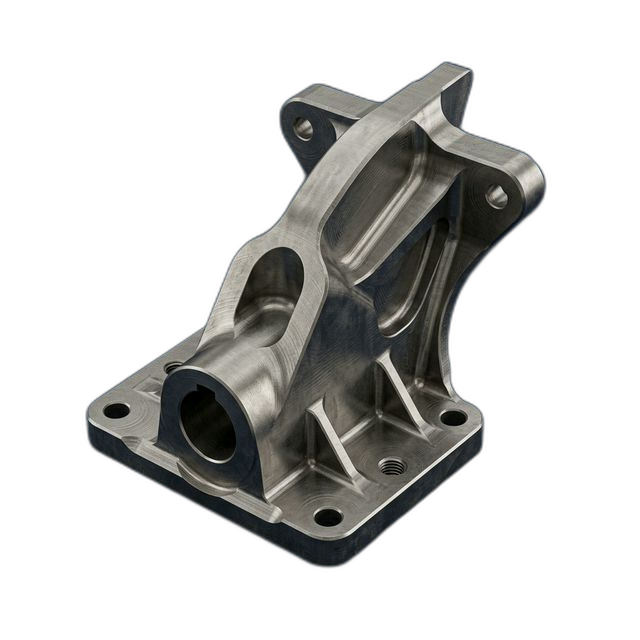
The Challenge
The customer’s original drawing called out ±0.0005” on every blend radius — including non-critical fillets that had no functional interface. Internal corners were specified sharp, which would have required wire EDM instead of conventional milling. Two separate datum schemes forced an unnecessary fixture change mid-cycle. Another shop had quoted three weeks.
Our Approach
Before programming a single toolpath, our team ran a full DFM review on the STEP file against the drawing. We flagged the over-toleranced radii, the EDM-forcing sharp corners, and the redundant datum structure. We sent the customer a marked-up revision with specific recommendations — no vague “simplify your part” feedback, just actionable changes tied to real machining constraints.
The Result
The customer accepted all three DFM changes. Machining time dropped by 35%. We delivered 20 flight-ready brackets in 6 business days with full first article inspection, material certification with heat lot traceability, and a certificate of conformance. Every part passed FAI with zero deviations.
Why This Part Was Expensive to Machine as Drawn
Titanium 6Al-4V is already one of the most demanding aerospace alloys to cut. It has low thermal conductivity, which means heat concentrates at the tool tip instead of dissipating into the chip. It work-hardens aggressively if the cutter dwells or rubs. And it has a strong affinity for carbide tooling, which accelerates flank wear if your speeds and feeds are off.
None of that is unusual — any competent shop can machine Ti 6Al-4V. What made this bracket expensive was the drawing itself. The customer had applied blanket ±0.0005” tolerances to every fillet and blend radius on the part, including transitions between non-critical ribs and gussets that serve no interface or sealing function. Holding ±0.0005” on a blend radius in titanium means slower feed rates, lighter radial depths of cut, and more spring passes to compensate for cutter deflection — all of which multiply cycle time.
Worse, the internal corners on two pockets were called out sharp. True sharp internal corners cannot be produced with a rotating endmill; they require wire EDM or sinker EDM. That means a secondary operation, a separate setup, a different machine, and additional lead time. For a structural bracket where those corners carry no gasket or mating surface, EDM is pure cost with no functional return.
The Three DFM Changes We Recommended
Our DFM review produced a marked-up PDF with three specific changes, each tied to the machining constraint it addressed:
- Relax non-critical radii from ±0.0005” to ±0.002”. We identified 11 blend radii on the part that had no mating interface, no sealing surface, and no assembly interaction. Relaxing these to ±0.002” — still a precision callout by any standard — allowed us to run conventional roughing and finishing passes at full programmed feed rates without spring passes. This single change eliminated roughly 18 minutes per part.
- Open internal corners to R0.060” to accept standard endmill geometry. A 1/8” (0.125” diameter) endmill produces a natural R0.0625” internal corner. By accepting R0.060” in the two non-critical pockets, we eliminated the need for EDM entirely. The bracket could be completed in a single CNC setup instead of routing through two departments.
- Consolidate two datum schemes into one. The original drawing referenced Datum A-B on the top features and a separate Datum D-E-F on the bottom face. This forced a fixture change and re-indication mid-cycle. We showed the customer that both datum schemes could reference a single A-B-C structure without affecting the GD&T callouts on critical mounting holes. One setup instead of two.
Machining Strategy for Ti 6Al-4V
Even after the DFM revisions, this bracket required careful process planning. Titanium’s thermal properties mean you cannot simply crank up the material removal rate — heat buildup causes thermal growth in the workpiece, which shifts feature positions relative to the datum. On a part with ±0.001” on critical bolt hole patterns, even 0.0003” of thermal drift matters.
We programmed adaptive (trochoidal) roughing toolpaths to maintain consistent chip load and prevent the cutter from burying in corners where heat spikes. Flood coolant at 300 PSI through-spindle kept the cutting zone temperature stable. For finishing passes on the critical mounting interfaces, we ran at reduced surface footage with a fresh insert to minimize built-up edge and ensure a clean, burr-free surface.
Fixturing was a custom-machined aluminum cradle that located on three datum surfaces simultaneously. This eliminated the second setup entirely — all critical features were machined in a single clamping, which removed any stack-up error between setups.
Inspection and Documentation
Every part was inspected on a CMM against the revised drawing. Critical mounting hole positions measured within ±0.0006” true position — well inside the ±0.001” callout. Non-critical radii were verified with optical comparator sweeps. Surface finish on mating faces measured 63 Ra as-machined, meeting the drawing requirement without secondary polishing.
All 20 parts shipped with a complete documentation package: first article inspection report per AS9102, material certification with heat lot traceability back to the mill, certificate of conformance, and the DFM revision markup showing exactly what changed from the original drawing and why.
What the Customer Said
“We’d been quoted three weeks and $X per piece by our usual vendor. RivCut came back with specific DFM feedback we could actually act on — not just ‘simplify your part.’ They cut our cost by 35%, delivered in less than a week, and every part passed incoming inspection. We’re sending them the next bracket revision.”
By the Numbers
Upload Your CAD File
Get instant AI pricing, a free DFM review, and full documentation on every order.
100% Made in USA · Never brokered · Ships anywhere in the US