
Brake Caliper Mounting Bracket — 4340 Steel with Full PPAP Documentation
A Tier 1 automotive supplier qualifying a new brake caliper design needed first-article parts with PPAP Level 3 documentation for OEM review. 4340 steel, heat treated to 38–42 HRC, with ±0.0005" bore true position held through a two-stage machine-then-grind process.
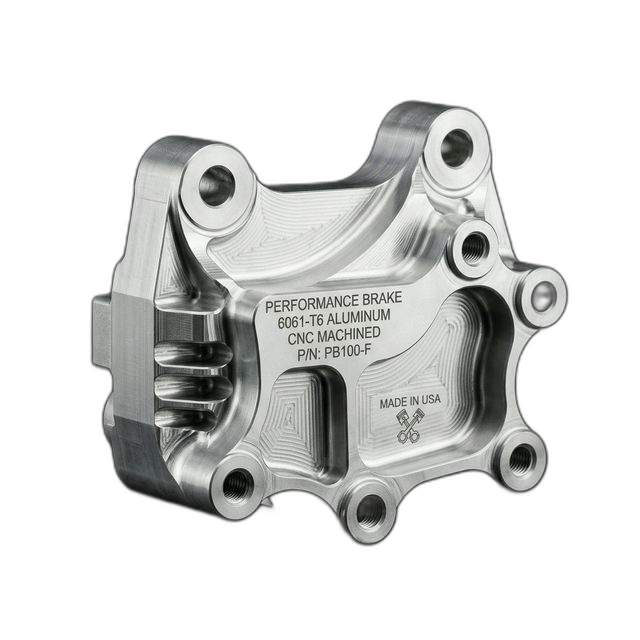
The Challenge
The bracket interfaces with both the steering knuckle and the caliper body. Bore true position on the caliper mounting pins must hold ±0.0005", and the knuckle mating face requires 0.001" flatness. Heat treatment after machining causes dimensional changes that must be pre-compensated in the initial machining setup.
Our Approach
Two-stage process: machine critical bores 0.002" oversize, send for heat treatment to 38–42 HRC, then finish-grind bores to final dimension. This accounts for heat treat distortion rather than fighting it. Final CMM inspection post-grind confirmed all dimensions within spec.
The Result
PPAP approved on first submission. The customer moved to a production release of 500 pieces per month. RivCut set up dedicated fixturing and SPC monitoring for the ongoing production run.
Why Heat-Treated Brake Brackets Are Difficult
Brake caliper mounting brackets are safety-critical. The bracket transfers braking force from the caliper, through the mounting pins, into the steering knuckle. If the pin bores are out of position, the caliper sits at an angle to the rotor, causing uneven pad wear, brake pull, and potentially reduced stopping performance. That’s why the OEM callout on bore true position is ±0.0005" — there’s no room for error on a component in the braking system.
The complication is heat treatment. 4340 steel needs to be hardened to 38–42 HRC for the tensile strength required in this application. But quench-and-temper heat treatment distorts the part. Bores that measured perfect before heat treat can come out 0.001–0.003" out of round and shifted in position. If you machine to final dimension before heat treat, you’re gambling that distortion falls within your tolerance band. On a ±0.0005" callout, that gamble almost always loses.
Two-Stage Process: Machine, Heat Treat, Grind
We planned for heat treat distortion from the start rather than hoping it wouldn’t happen:
- Stage 1 — CNC machining. Machined all features to final dimension except the critical caliper mounting bores, which were left 0.002" oversize on diameter. The knuckle mating face was finished to 0.001" flatness at this stage since heat treat has minimal impact on external flat surfaces when properly fixtured during quench.
- Heat treatment. Sent to our heat treat partner for quench and temper to 38–42 HRC. Each part was hardness tested on return — all 25 came back in the 39–41 HRC range. We also measured bore distortion post-heat treat to confirm our 0.002" stock allowance was sufficient. Maximum measured distortion was 0.0015".
- Stage 2 — Finish grinding. Ground the caliper mounting bores to final dimension and true position. Grinding after heat treat removes the distorted material and produces the final geometry in the hardened state. This is the only reliable way to hold ±0.0005" on bores in hardened 4340.
PPAP Level 3 Documentation
The customer’s OEM required PPAP Level 3 for supplier qualification. This isn’t just a dimensional report — it’s a full process validation package that demonstrates the manufacturing process is capable and controlled. RivCut prepared the complete package:
- Dimensional results. CMM inspection data on all 25 pieces, with balloon-referenced drawings showing every measured dimension against the tolerance callout.
- Process flow diagram. Step-by-step manufacturing sequence from raw material receipt through final inspection, including the heat treatment stage and incoming hardness verification.
- Control plan. Documented controls for each process step — what gets measured, how often, with what instrument, and what the reaction plan is if something goes out of spec.
- MSA (Gage R&R). Measurement system analysis demonstrating that our CMM setup has sufficient resolution and repeatability for the ±0.0005" tolerance. The study confirmed gage R&R under 10% of tolerance — well within the acceptable range.
- Initial process capability (Cpk). Statistical analysis of the 25-piece sample lot demonstrating process capability. Bore true position showed Cpk > 1.67 — exceeding the typical automotive requirement of 1.33 for safety-critical features.
Material: 4340 Steel
4340 is the standard choice for high-strength structural components in braking systems. It’s a nickel-chromium-molybdenum alloy steel with excellent hardenability — it through-hardens uniformly even in thicker cross-sections, which is important for a bracket that sees high cyclic loading. At 38–42 HRC, 4340 provides the tensile strength (approximately 180–200 ksi) needed to handle braking forces without plastic deformation over the life of the vehicle.
Production Transition
After PPAP approval, the customer released 500 pieces per month for production. We set up dedicated fixturing to eliminate setup time on repeat orders and implemented SPC monitoring on the critical bore dimensions. Control charts run on every lot — if bore true position trends toward the control limit, we adjust before parts go out of spec. That’s the difference between reactive quality (inspecting defects) and proactive quality (preventing them).
By the Numbers
Upload Your CAD File
Get instant AI pricing, a free DFM review, and full documentation on every order.
100% Made in USA · Never brokered · Ships anywhere in the US