
EV Battery Module Housing — 7075-T6 Aluminum with Serpentine Cooling Channels
An EV startup needed prototype battery module housings for thermal testing. The housing routes glycol coolant through serpentine channels around battery cells — channel geometry directly impacts thermal performance and cell longevity. Thin channel walls required DFM intervention to maintain machinability.
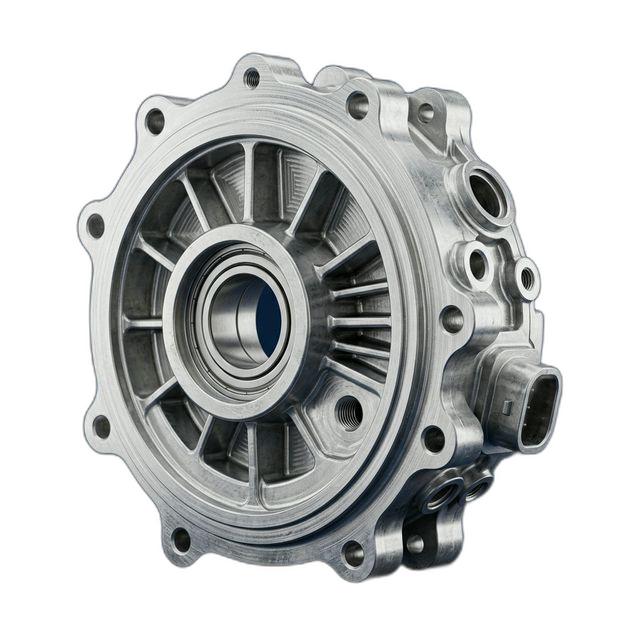
The Challenge
Internal cooling channels with complex serpentine geometry and 0.050" wall thickness. Any deflection during machining reduces the coolant flow cross-section, degrading thermal performance. The cell mounting face required 0.001" flatness for proper TIM compression, and O-ring grooves on the lid interface had to be concentric to ±0.0005" to prevent coolant leaks.
Our DFM Insight
The customer’s original design specified 0.030" walls on the cooling channels — too thin for reliable machining without workholding support. We recommended increasing to 0.050" and adjusting channel depth to maintain equivalent coolant flow cross-section. Their thermal simulation confirmed zero performance impact from the geometry change.
The Result
All 8 prototypes passed thermal testing. The DFM wall thickness change eliminated machining risk with zero thermal penalty. Customer ordered V2 with minor channel routing changes — 3-day turnaround on the revision, no setup fees since we retained the fixturing.
Why EV Battery Housings Are Difficult to Machine
Battery module housings for EVs serve a dual purpose: structural enclosure and thermal management. The cooling channels machined into the housing route glycol coolant in a serpentine path that wraps around each cell group. The thermal performance of the pack depends directly on the channel geometry — cross-sectional area determines flow rate, and wall thickness affects heat transfer from the cells into the coolant.
The machining difficulty comes from the thin channel walls. At 0.050", the walls are flexible enough to deflect under cutting forces if you’re not careful with feeds, speeds, and tool engagement. Deflection reduces the channel cross-section on one side and opens it on the other, creating uneven coolant flow distribution across the cell array. In thermal testing, that shows up as hot spots — exactly what the customer was trying to eliminate.
On top of the channel geometry, the cell mounting face has to be flat within 0.001". Thermal interface material (TIM) between the cells and housing requires consistent compression to conduct heat effectively. If the face is bowed or wavy, some cells run hotter than others, which accelerates degradation and creates safety risk in the pack.
How We Approached It
Before programming, our machinist reviewed the model and flagged the 0.030" channel walls as a risk. At that thickness, even with light finishing passes, tool pressure would cause measurable deflection. We proposed a design change:
- Wall thickness: 0.030" → 0.050". Increased channel wall thickness to eliminate deflection risk during machining. The additional 0.020" provides enough rigidity to hold dimension through the finishing pass without requiring custom support fixtures.
- Channel depth adjustment. Deepened the channels proportionally to maintain the same cross-sectional area. Equivalent flow cross-section means identical coolant flow rate and pressure drop at the same pump setting. The customer ran CFD on the revised geometry and confirmed no change in thermal performance.
- Machining sequence. Roughed the channels first with 0.010" stock remaining, then finished the cell mounting face to establish the flatness datum, then took the final channel finishing pass. This order prevents channel machining forces from distorting the cell face after it’s been finished.
The O-ring grooves on the lid interface were machined in a single setup with the mating face to ensure concentricity. We used a form tool matched to the O-ring cross-section to cut the groove in one pass, eliminating the runout that comes from multiple passes with a standard endmill.
Material Selection: 7075-T6 Aluminum
The customer selected 7075-T6 for its high strength-to-weight ratio — the housing is a structural member in the battery pack, and weight matters in an EV application. 7075-T6 also has reasonable thermal conductivity (130 W/m·K), which helps transfer heat from the cells through the channel walls into the coolant. It machines well in the T6 temper, producing good surface finishes in the channels without requiring secondary polishing.
Surface Finish: Alodine Chromate Conversion
The housing received Alodine (chromate conversion coating per MIL-DTL-5541) for corrosion protection. Alodine was the right choice here because it adds negligible thickness — less than 0.0001" — which means no dimensional impact on the O-ring groove or mating surfaces. Anodize would have added 0.001–0.002" per surface, requiring compensation on every critical dimension. For a prototype run where the customer needs to validate fit and thermal performance, Alodine gives corrosion protection without complicating the dimensional picture.
CMM Inspection
Every housing was CMM inspected. We measured the full serpentine channel path at 20 points per channel, the cell face flatness across a 5×5 grid, and the O-ring groove diameter, depth, and concentricity. All 8 parts came in within tolerance. Channel dimensions held ±0.0008" — well within the ±0.001" callout. O-ring grooves measured ±0.0003" on concentricity against the ±0.0005" requirement.
By the Numbers
Upload Your CAD File
Get instant AI pricing, a free DFM review, and full documentation on every order.
100% Made in USA · Never brokered · Ships anywhere in the US