
Transmission Test Fixture — 4140 Steel, Precision Ground Bearing Journals
A Tier 1 transmission manufacturer needed precision test fixtures for their end-of-line gear mesh quality station. The fixture locates the transmission output shaft and applies controlled load while measuring gear mesh noise and vibration — fixture accuracy directly determines measurement repeatability and false-reject rates.
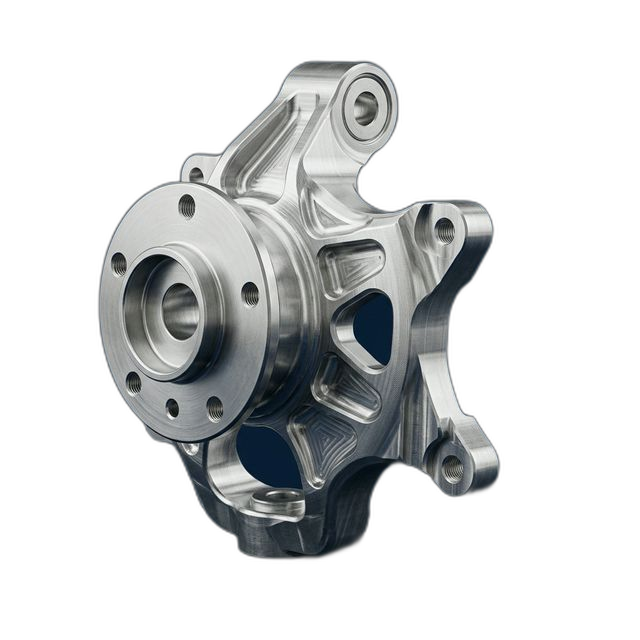
The Challenge
Bearing journal seats must be cylindrical within 0.0002" and concentric to the fixture centerline within 0.0003". Locating pin bores ±0.0002" true position to interface with the existing test cell mounting table. The fixture will be loaded and unloaded 500+ times per day — wear on datum surfaces would degrade measurement accuracy over time.
Our Approach
Pre-hardened 4140 billet at 28–32 HRC. Bearing seats precision-ground after milling for cylindricity. Locating pins bored in the same setup as bearing journals for guaranteed concentricity. Datum surfaces nitrided for wear resistance without distorting core dimensions.
The Result
Gage R&R study showed fixture repeatability of 0.5% (spec: <5%). False reject rate dropped from 3.2% to 0.4% after installing the new fixtures. Customer estimated $180K annual savings from reduced false rejects.
Why Transmission Test Fixtures Demand Sub-Tenth Precision
End-of-line transmission testing measures gear mesh quality by monitoring noise and vibration signatures as the transmission runs under load. The test fixture holds the output shaft in the same orientation and position every cycle — any variation in fixture location shows up as measurement noise, making it impossible to distinguish a bad transmission from a bad fixture setup.
The bearing journal seats are the most critical features. They support the output shaft bearings and establish the shaft’s rotational axis relative to the measurement sensors. If the journal has cylindricity error, the shaft wobbles during rotation, creating vibration that the sensors pick up as gear mesh noise — a false positive. Concentricity error between the journals shifts the shaft axis, changing the gear mesh contact pattern and producing a different noise signature than the transmission would create in the vehicle.
The consequence of poor fixture accuracy is false rejects: transmissions that test as “noisy” but are actually fine. At 500 tests per day, even a 3% false reject rate means 15 transmissions per day pulled off the line for re-test or teardown inspection. That’s expensive — each false reject costs labor, delays shipment, and sometimes results in unnecessary rework of a good unit.
How We Built It
The manufacturing sequence was designed to achieve the geometric relationships between features, not just the individual dimensions. Every decision in the process plan traced back to ensuring the bearing journals and locating pins shared a common datum chain:
- Pre-hardened 4140 billet (28–32 HRC). Starting with pre-hardened material eliminates heat treat distortion after machining. 4140 in this hardness range is still machinable with carbide tooling, though feeds are reduced compared to annealed stock. The payoff is dimensional stability — what you machine is what you keep.
- Bearing seats ground after milling. We milled the bearing journal seats to within 0.001", then finished them on the cylindrical grinder for 0.0002" cylindricity. Grinding removes the last few tenths that milling can’t reliably hold, and produces the surface finish needed for bearing contact — 16 Ra or better.
- Single-setup boring for concentricity. The locating pin bores were machined in the same setup as the bearing journal grinding operation, using the journal centerline as the rotational datum. This guarantees the geometric relationship between the two feature sets — no stack-up from fixture transfer between setups.
- Nitrided datum surfaces for wear life. The datum contact faces — where the fixture seats against the test cell table and where the transmission housing bears against the fixture — were gas nitrided to 60+ HRC surface hardness. Nitriding is a diffusion process that hardens only the surface layer (0.010–0.015" deep) without changing the core hardness or causing distortion. This gives the wearing surfaces 10× the wear life of the base material.
Material Selection: 4140 Steel at 28–32 HRC
4140 is the standard fixture material in automotive production environments. At 28–32 HRC, it provides the wear resistance needed for repetitive fixturing loads while remaining machinable with carbide tooling. The pre-hardened condition eliminates the risk of heat treat distortion — critical when the fixture’s entire purpose depends on holding geometric relationships to tenths of thousandths. 4140 also has excellent dimensional stability over temperature, which matters in a production environment where fixture temperature can vary 20–30°F over a shift.
Surface Finish: Black Oxide + Nitrided Datum Surfaces
The fixture body received black oxide for corrosion protection and shop-floor durability. Black oxide adds no measurable thickness, so non-critical dimensions are unaffected. The datum and bearing contact surfaces were selectively nitrided before black oxide application. The nitrided surfaces are easily identified visually (they have a distinctive matte gray appearance) which helps operators orient the fixture correctly during installation.
CMM Inspection & Qualification
Both fixtures were fully CMM inspected for cylindricity, concentricity, true position, and surface finish. Cylindricity on the bearing journals measured 0.00015" — better than the 0.0002" spec. Concentricity between journals and locating pin pattern measured 0.00025" against the 0.0003" requirement. Hardness was verified at 5 locations per fixture, all reading 29–31 HRC. The customer ran a 30-part Gage R&R study using both fixtures and achieved 0.5% repeatability — an order of magnitude better than the 5% threshold.
By the Numbers
Upload Your CAD File
Get instant AI pricing, a free DFM review, and full documentation on every order.
100% Made in USA · Never brokered · Ships anywhere in the US