
Ruggedized Communications Housing — Inconel 718
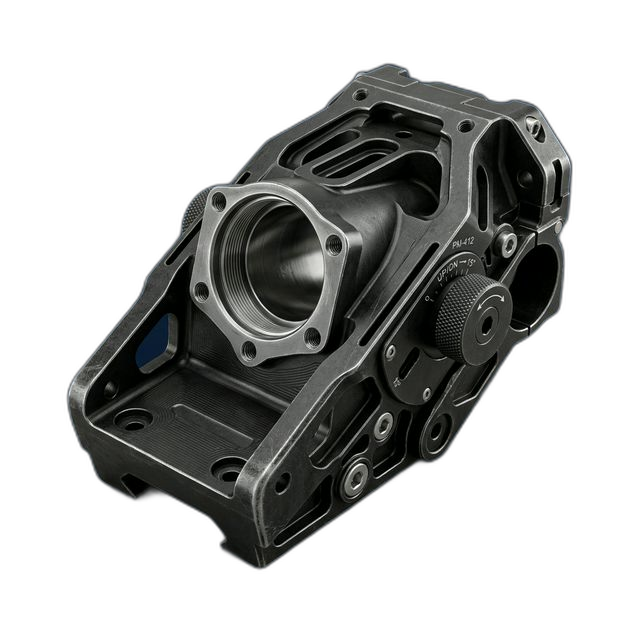
A defense comms OEM needed a ruggedized housing for a field-deployed communications module exposed to extreme heat and corrosive environments — desert salt flats, maritime installations, forward operating bases. The material had to survive where aluminum and steel would corrode or fatigue. That meant Inconel 718.
The Challenge
Deep pocket machining at 3:1 depth-to-width in Inconel 718 — a material that work-hardens the moment your tool rubs instead of cuts. The housing had 0.060″ thin-wall heat dissipation fins that would deflect or crack under conventional machining forces. One broken tool in a deep pocket can scrap a $400+ billet.
Our Approach
High-pressure through-spindle coolant at 1,000+ PSI. Ceramic insert roughing to hog material fast before work-hardening set in, followed by carbide finishing passes. Aggressive chip thinning to keep the cutting edge engaged. In-process inspection every 4 cavities to catch tool wear before it became tool failure.
The Result
All 6 housings passed dimensional inspection. Zero tool breakage. Zero scrap. Pocket depths held to ±0.001″, walls maintained within ±0.003″ of the 0.060″ nominal, and surface finish came in at 32 Ra across all pocket floors.
Why Inconel 718 Breaks Shops
Most machine shops will quote Inconel and then regret it. The material has a few properties that conspire to destroy tooling and scrap parts if your process isn’t dialed in.
First, Inconel 718 work-hardens rapidly. If the cutting edge rubs instead of shearing — even for a fraction of a second — the surface layer hardens to the point where the next pass can’t penetrate. The tool rides on top of a hardened skin, generates heat, hardens the layer further, and the cycle accelerates until the insert fractures or the surface is ruined.
Second, Inconel doesn’t conduct heat well. In aluminum, about 75% of the cutting heat leaves with the chip. In Inconel, most of the heat stays in the workpiece and the tool. Crater wear and notch wear on the insert happen fast — a tool that lasts 45 minutes in steel might last 8 minutes in Inconel at the same parameters.
Third, the material is gummy. Chips don’t break cleanly — they string and reweld to the cutting edge if coolant pressure isn’t sufficient to flush them out of deep pockets. In a 3:1 pocket, a bird’s nest of Inconel chips wrapped around the tool is a fast path to tool breakage and a scrapped part.
Our Machining Strategy
We broke the job into two distinct phases with different tooling philosophies for each:
- Phase 1 — Ceramic roughing. We used ceramic end mills for the bulk material removal. Ceramics run at significantly higher surface speeds than carbide (800+ SFM vs. 100–150 SFM) and thrive in the heat that kills carbide tools. The trade-off is they’re brittle and can’t handle interrupted cuts well, so we programmed smooth, continuous toolpaths with no sudden direction changes. Through-spindle coolant at 1,000+ PSI kept the chips evacuated from the deep pockets and prevented re-cutting.
- Phase 2 — Carbide finishing. Once the pockets were roughed to within 0.015″ of final dimension, we switched to coated carbide end mills for the finishing passes. Lower surface speed, controlled chip load, and constant radial engagement to prevent the intermittent cutting that causes work-hardening. We used aggressive chip thinning — programming a larger radial stepover than the effective chip load would suggest — to ensure the cutting edge always took a real chip, never rubbed.
- In-process tool wear monitoring. We inspected inserts and measured pocket dimensions every 4 cavities. Inconel tool wear isn’t linear — a tool can look fine for 3 pockets and then fail catastrophically on the 4th. By checking at regular intervals, we caught wear progression before it reached the failure zone and swapped tools proactively. This is why we had zero breakage across all 6 housings.
Thin-Wall Fin Machining
The 0.060″ heat dissipation fins were the highest-risk feature on the part. Thin walls in Inconel want to deflect away from the cutter, chatter, and either go out of tolerance or crack at the base radius. We took a few specific steps to manage this:
We machined the fins in alternating passes — taking material from one side, then the other, so cutting forces were balanced and the wall didn’t get pushed to one side. We reduced axial depth of cut on the finishing passes to keep cutting forces below the deflection threshold. And we left a thin web of stock connecting adjacent fins during roughing, removing it only on the final pass, so the fins had structural support throughout most of the machining cycle.
Final wall thickness held within ±0.003″ of the 0.060″ nominal across all fins on all 6 housings.
Material and Documentation
The Inconel 718 bar stock was sourced to AMS 5662 and verified with full mill certification on incoming inspection. AMS 5662 covers the precipitation-hardened condition — solution treated and aged — which gives Inconel 718 its full strength (tensile around 185 ksi, yield around 150 ksi at room temperature).
Because Inconel 718 self-passivates through its native chromium oxide layer, no post-machining surface treatment was required. The as-machined surface met the customer’s corrosion requirements without additional processing.
All parts shipped with CMM dimensional data, material certification with heat lot traceability, Certificate of Conformance, and process documentation. Material sourcing was DFARS-compliant.
ITAR-Aware Handling
This project involved defense-controlled technical data. RivCut’s ITAR registration is in progress, and all drawings, CAD files, and process documentation were handled under ITAR access control requirements with access restricted to U.S. persons only.
By the Numbers
Upload Your CAD File
Get instant AI pricing, a free DFM review, and full documentation on every order.
100% Made in USA · Never brokered · Ships anywhere in the US