
Armored Vehicle Periscope Mount — 17-4 PH H1025
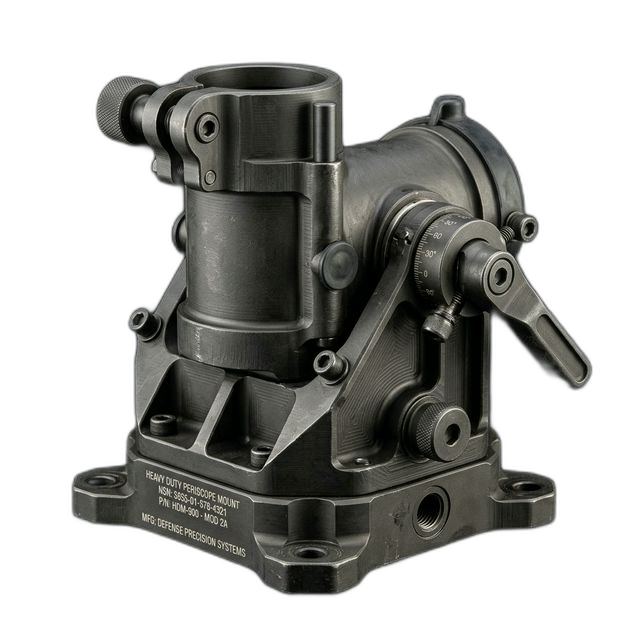
A vehicle integrator building armored reconnaissance vehicles needed periscope mounting brackets that absorb blast and ballistic shock while maintaining periscope alignment after impact events. Dimensional stability under shock loading is the critical requirement — if the mount shifts, the crew loses their primary observation capability.
The Challenge
Periscope bore concentricity ±0.0005″ with perpendicularity to the mounting face within 0.0003″. The material — 17-4 PH pre-hardened to H1025 condition (38–42 HRC) — means shorter tool life and higher risk of surface damage during bore finishing. The mounting bolt pattern must align with the existing vehicle hull interface with zero field modification.
Our Approach
Received material pre-hardened to H1025 condition. Used CBN (cubic boron nitride) inserts for bore finishing — single pass at controlled depth of cut to achieve tolerance and surface finish simultaneously. Through-spindle coolant for chip evacuation in the deep bore. Bolt pattern fixtured on an existing hull interface template to guarantee alignment.
The Result
All bores within ±0.0003″. Customer’s shock testing per MIL-STD-810H confirmed zero dimensional shift after 500g blast impulse. All 6 mounts installed on hull interfaces without modification. Full documentation package shipped with every part.
Why Pre-Hardened Material Changes the Machining Equation
Most machine shops prefer to machine 17-4 PH in its annealed or solution-treated condition, then send it out for heat treatment afterward. That’s the easy path. But for this application, the customer specified receiving the material already hardened to H1025 condition — and for good reason.
Heat treating after machining introduces distortion risk. On a periscope mount where bore concentricity is ±0.0005″ and perpendicularity to the mounting face is 0.0003″, even minor distortion from the precipitation hardening cycle (900°F for 4 hours, air cool) can push critical features out of tolerance. The customer had experienced this on previous lots from other vendors — parts that inspected good before heat treat came back out of spec, requiring costly rework or scrap.
So we received 17-4 PH bar stock already hardened to H1025 condition: 38–42 HRC, 145 ksi ultimate tensile strength. That eliminates post-machining distortion risk entirely, but it means we’re machining a material that’s roughly as hard as a hardened tool steel. Tool life drops dramatically, surface finish becomes harder to control, and the bore finishing strategy has to change completely.
CBN Bore Finishing in Hardened 17-4 PH
At 38–42 HRC, carbide boring bars lose their edge faster than the cycle time allows for consistent results across 6 parts. We switched to CBN (cubic boron nitride) inserts for the bore finishing operation:
- Single-pass bore finishing. CBN inserts maintain their cutting edge geometry across the entire lot. We dialed in the depth of cut, feed rate, and surface speed on the first piece, confirmed the bore diameter and finish, and then ran all 6 parts with the same insert. No mid-lot tool changes that could introduce diameter variation between parts.
- Through-spindle coolant for deep bores. The periscope bore has a depth-to-diameter ratio that makes chip evacuation the primary failure mode. Packed chips re-cut and damage the bore surface. We ran through-spindle coolant at high pressure to flush chips out of the bore as they formed, preventing any re-cutting or surface scoring.
- Controlled depth of cut for simultaneous tolerance and finish. On hardened material, you can’t separate the roughing and finishing mindset the way you can on soft stock. The depth of cut on the finish pass determines both the dimensional result and the surface finish. Too light, and the insert rubs instead of cuts — work-hardening the surface and producing a poor finish. Too heavy, and deflection pushes you out of tolerance. We calibrated the DOC to sit in the sweet spot where the CBN insert cuts cleanly and consistently.
- Hull interface template fixturing. The customer provided a fixture template that replicated the bolt hole pattern of the actual vehicle hull interface. We mounted each part on this template during the bolt pattern drilling operation, guaranteeing that the bolt pattern on the finished mount matched the hull interface exactly. No shimming, no field drilling, no modification required during vehicle integration.
Material: 17-4 PH Stainless, Condition H1025
H1025 is the most commonly specified condition for 17-4 PH in applications that need both high strength and impact toughness. At 145 ksi UTS and a Charpy V-notch impact energy around 35 ft-lbs at room temperature, it provides the combination of properties needed for a mount that must survive blast and ballistic shock events without fracturing or permanently deforming.
We sourced DFARS-compliant 17-4 PH bar stock with full material certification including the heat treatment report confirming H1025 condition. Incoming hardness was verified at 40 HRC, mid-range for the H1025 specification. The heat lot traceability was maintained from raw stock through finished parts.
Passivation
All 6 mounts were passivated per ASTM A967 after machining. Passivation removes free iron from the machined surfaces and restores the chromium oxide passive layer. On a part that will be installed in a vehicle hull potentially exposed to saltwater, road chemicals, and humidity, a fully passivated surface is the baseline corrosion protection.
ITAR-Aware Handling
This project involved defense-controlled technical data for an armored vehicle subsystem. RivCut’s ITAR registration is in progress, and we handled all drawings, CAD files, and process documentation in accordance with ITAR access control requirements. Files were stored on secured systems with access limited to U.S. persons only. No technical data was shared outside the facility.
By the Numbers
Upload Your CAD File
Get instant AI pricing, a free DFM review, and full documentation on every order.
100% Made in USA · Never brokered · Ships anywhere in the US