
Smart Speaker Enclosure — 6061-T6 Aluminum
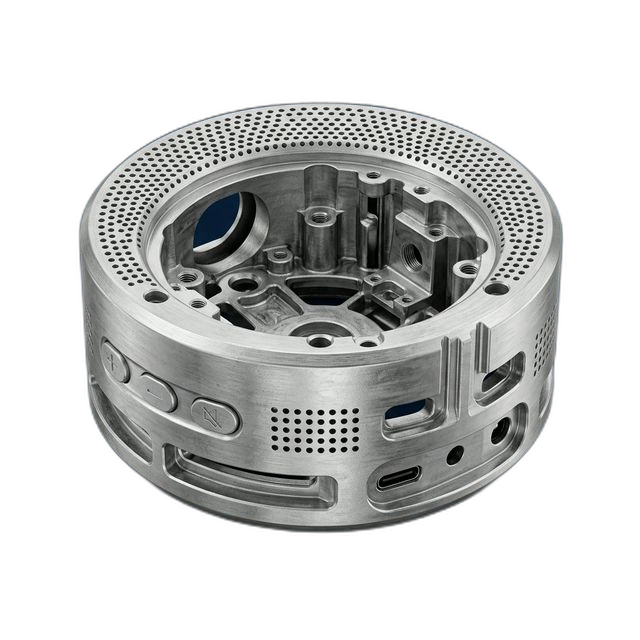
An audio hardware startup building a premium smart speaker needed a single-piece machined aluminum body with internal acoustic chamber geometry optimized for bass response. CNC machining from billet gives them the mass and rigidity that injection molding can’t match for audio quality — and they had a CES demo deadline.
The Challenge
Internal acoustic chamber has compound curved surfaces that shape the sound wave path — profile tolerance ±0.005". Wall thickness varies from 6mm (bass chamber) to 2mm (mounting flange), with thin sections prone to chatter. External surface must be cosmetically perfect — no tool marks visible after anodize.
Our Approach
Internal chamber finished with ball-nose endmill in continuous 5-axis sweep (no retract marks). External surfaces diamond-polished for mirror-like as-machined finish. Thin wall sections stabilized with wax fill during external finishing to prevent chatter.
The Result
Acoustic testing showed 8 dB improvement in bass response vs. injection-molded prototype. Zero cosmetic rejects. Product won a CES Innovation Award. Customer ordered a 500-unit production run.
Why This Part Is Hard to Machine
From the outside, this is a beautifully simple aluminum cylinder. Inside, it’s an acoustic instrument. The internal chamber has compound curved surfaces designed by the customer’s audio engineering team to shape the sound wave path for optimal bass response. These curves must be machined to ±0.005" profile tolerance — deviations change the acoustic behavior and the speaker sounds different from unit to unit.
The wall thickness varies dramatically: 6mm at the bass chamber (mass is needed to dampen unwanted resonances) and just 2mm at the mounting flange where the driver seats. When you’re machining the internal chamber with a long-reach endmill, those thin flange sections want to vibrate. Chatter during internal machining shows up as witness lines on the external surface — lines that become glaringly visible after anodize.
The external surface standard is effectively zero defects. For a premium consumer product headed to CES, any visible tool mark, scratch, or machining witness line is a reject. The driver mounting bore must be held to ±0.001" for flush speaker seating — a proud or recessed driver looks and sounds wrong.
How We Solved It
We ran a free DFM review and worked with the customer’s audio team to understand which chamber dimensions were acoustically critical vs. where we had tolerance margin. Here’s the machining strategy:
- Continuous 5-axis sweep for internal chamber. We roughed the internal chamber with a long-reach endmill, then finished the compound curves with a ball-nose endmill in a continuous 5-axis sweep. No tool retracts during the finish pass means no retract marks on the acoustic surfaces. The continuous toolpath also produces a more uniform surface finish, which matters for predictable sound reflection.
- Diamond-polished endmill for external surfaces. We finish-machined all external surfaces with a diamond-polished endmill that produces a mirror-like as-machined finish. This eliminates the need for hand polishing before anodize — hand polishing is inconsistent and can create waviness visible in reflective anodized finishes. The as-machined finish went straight to bead blast and anodize.
- Wax fill for thin-wall stabilization. After roughing the internal chamber, we filled it with machinable wax before finish-machining the external surfaces. The wax provides support behind the thin 2mm flange sections, preventing chatter during external finishing. After external machining, the wax was melted out and the parts cleaned before anodize.
Surface Finish and Post-Processing
All external surfaces were bead blasted for a uniform matte texture, then sent for space gray Type II anodize. The anodize color was matched to the customer’s brand spec with test coupons before processing the production batch. The driver mounting bore was masked during anodize to maintain the ±0.001" fit tolerance.
Internal acoustic surfaces were left as-machined to preserve the precise surface profile. The ball-nose finish pass produced a consistent surface roughness that the audio team confirmed had no measurable impact on sound reflection characteristics.
What the Customer Said
“We showed up at CES with ten machined aluminum speakers and people couldn’t believe they were prototypes. The bass response blew away our injection-molded version — 8 dB improvement, and every unit sounded identical. We won a CES Innovation Award and came back to RivCut for a 500-unit production run. They’re basically our manufacturing team now.”
By the Numbers
Upload Your CAD File
Get instant AI pricing, a free DFM review, and full documentation on every order.
No setup fees between iterations · Free DFM review · Ships anywhere in the US