
Orthopedic Drill Guide — 17-4 PH Stainless Steel for Knee Replacement Surgery
An orthopedic device company needed patient-specific drill guides that sit on the femur and direct the surgeon’s drill to precise compound angles for implant screw placement. Angular accuracy determines implant alignment — and long-term patient outcomes.
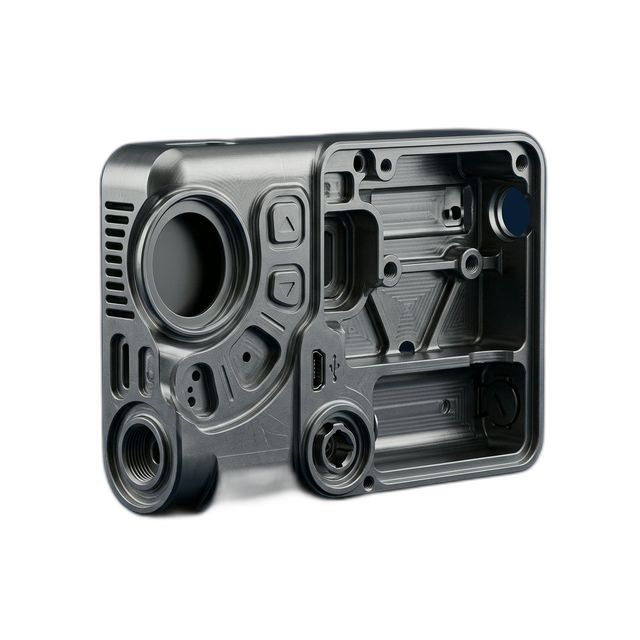
The Challenge
Five guide tube bores on compound angles — no two parallel — must be angular-accurate to within ±0.5° in two planes relative to the bone contact surface. Bore-to-bore spacing must hold ±0.005″ to match patient anatomy derived from CT scan data. The part must withstand 300+ autoclave cycles without dimensional drift.
Our Approach
5-axis simultaneous positioning for each bore angle. Custom fixture referenced the bone contact surface (Datum A) to ensure angular accuracy is relative to the anatomy interface. All five bores drilled and reamed in a single setup — no re-fixturing between bores. Test piece validated angular accuracy with CMM before the production run.
The Result
Angular accuracy verified at ±0.3° — beating the ±0.5° specification. Surgeon evaluation confirmed drill placement accuracy on cadaver testing. The guides were cleared for limited clinical use.
Why Patient-Specific Drill Guides Are Demanding
A drill guide for knee replacement surgery isn’t a generic jig — it’s a patient-specific instrument derived from CT scan geometry. The bone contact surface is a complex, anatomically contoured shape that must nest precisely onto the patient’s femur. Every guide bore angle is calculated from the patient’s unique anatomy, so no two guides in a production lot share the same compound angles.
The angular accuracy requirement is the critical constraint. If a bore is off by even 1°, the implant screw enters the bone at the wrong trajectory. Multiply that across five bores, and the cumulative alignment error can compromise the implant’s fit, the patient’s range of motion, and the long-term survivorship of the prosthesis. Surgeons stake their clinical outcomes on these guides being right.
17-4 PH Stainless Steel in Condition H900 was selected for its combination of high hardness (approximately 44 HRC) and corrosion resistance. The guide bushings must resist wear from the drill bit without galling or burring — a softer material would deteriorate after repeated drilling procedures. And the part must survive 300+ autoclave sterilization cycles at 134°C without dimensional creep or surface degradation.
How We Solved It
Our free DFM review identified three critical risks before programming began:
- Datum A fixture referencing bone contact surface. We machined a custom fixture that located the guide on its bone contact surface — the same surface that interfaces with the patient’s anatomy. This means every angular measurement is taken relative to the actual functional datum, not a convenient machining datum. The fixture was machined from the same CT-derived surface data the customer provided.
- 5-axis simultaneous positioning — single setup. All five bores were drilled and reamed with the part fixtured once. Each bore required the 5-axis head to orient to a unique compound angle. By keeping the part in a single setup, we eliminated the stack-up error that comes from re-fixturing between bores. The bore-to-bore positional accuracy depended entirely on machine repeatability — not operator alignment.
- Test piece validation before production. Before cutting any of the 20 production guides, we ran a single test piece through the complete process: machine, electropolish, CMM inspection of all five bore angles. The test piece confirmed ±0.3° angular accuracy — well within the ±0.5° specification. Only after the test piece passed CMM did we proceed to the full lot.
Left and Right Configurations
The 20-piece lot consisted of 10 left-knee and 10 right-knee configurations. While the overall guide geometry mirrors between left and right, the bore angles are not simple mirror images — each configuration has its own unique set of compound angles derived from the patient population’s anatomical data. We maintained separate programs for left and right configurations, and the CMM inspection data is tracked per configuration to ensure full traceability.
Electropolish for Biocompatibility
After machining, all 20 guides were electropolished. Electropolishing removes the outermost layer of material — including any embedded contaminants from machining — and produces a smooth, passive surface that resists corrosion and biofilm formation. For a device that contacts bone and is sterilized hundreds of times, surface integrity is non-negotiable. We managed the electropolish vendor relationship and provided electropolish certification as part of the documentation package.
Documentation for Clinical-Track Devices
The customer required documentation that would support their clinical evaluation submission. We provided CMM angular data for every bore on every guide, material certification for 17-4 PH with heat treatment verification to Condition H900, Certificate of Conformance, electropolish certification, and an autoclave compatibility statement. Every document was revision-controlled and traceable to the specific lot.
By the Numbers
“The single-setup approach eliminated re-fixturing error entirely. Every bore angle traced back to the bone contact datum — exactly how the surgeon uses the guide in the OR.”
Upload Your CAD File
Get instant AI pricing, a free DFM review, and full documentation on every order.
100% Made in USA · Never brokered · Ships anywhere in the US