
Spinal Implant Trial Component — Titanium 6Al-4V ELI
A spine device company developing a new interbody fusion cage needed trial and sizing components that match implant geometry exactly. Surgeons use trials intraoperatively to determine correct implant size — instrument interface fit is critical.
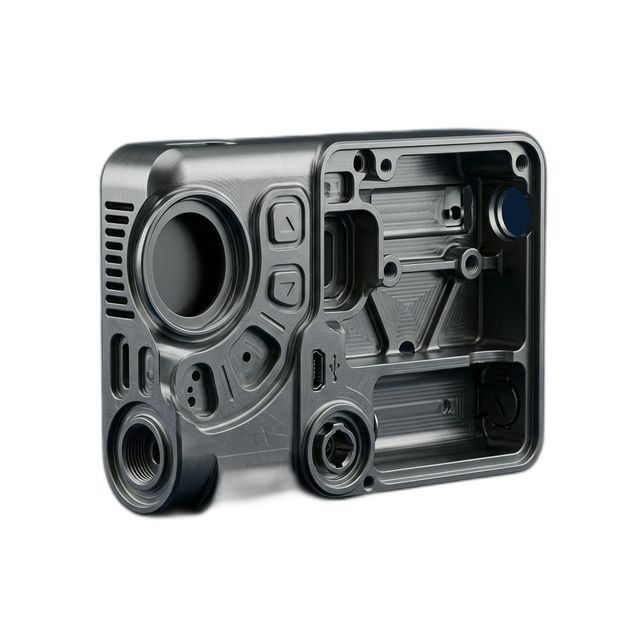
The Challenge
Eight trial sizes, each differing by 1mm height increment. Serrated teeth on superior and inferior surfaces — 0.5mm pitch, 0.3mm depth, 60° included angle — for bone grip simulation. The instrument interface bore must hold ±0.0005″ so trials fit the same instruments as the permanent implants.
Our Approach
Parametric template programming — only the height dimension changes between sizes, so qualifying the first size validated the machining strategy for all eight. Teeth cut with a form endmill ground to match tooth profile. Instrument bore machined last to prevent distortion from teeth cutting forces.
The Result
All 24 trials fit the instrument set on first attempt. Surgeon evaluation confirmed sizing accuracy. The company used these trials for their 510(k) submission cadaver study.
Why Spinal Trial Components Demand Precision
In spinal fusion surgery, the surgeon inserts a trial component into the disc space to evaluate size and fit before placing the permanent implant. The trial must replicate the permanent implant’s geometry closely enough that the surgeon’s size selection is reliable — if the trial fits differently than the implant, the surgeon may choose the wrong size, leading to implant subsidence or instability.
The critical interface is the instrument bore. The trial attaches to the same insertion instruments as the permanent implant. If the bore is oversized, the trial wobbles on the instrument and the surgeon loses tactile feedback. If it’s undersized, the trial won’t engage the instrument at all. The ±0.0005″ tolerance on this bore is not arbitrary — it’s driven by the instrument engagement mechanism.
Titanium 6Al-4V ELI (Extra Low Interstitial) per ASTM F136 is the standard biocompatible titanium for implantable devices. The ELI grade has lower oxygen and iron content than standard Ti 6Al-4V, providing superior fatigue properties. Even though trials aren’t permanently implanted, they contact tissue and must be biocompatible.
How We Solved It
Our programming approach focused on efficiency and consistency across all eight sizes:
- Parametric template for 8 sizes. We programmed a master template where only the height dimension is parametric. Once the first size was qualified — teeth geometry confirmed, instrument bore verified, surface finish measured — we knew the remaining seven sizes would machine identically. This reduced programming time from 8× to essentially 1× plus verification.
- Form endmill for serrated teeth. The serrated teeth on the superior and inferior surfaces require a specific profile: 0.5mm pitch, 0.3mm depth, 60° included angle. Rather than attempting to generate this profile with standard tooling and multiple passes, we used a form endmill ground to match the exact tooth geometry. One pass per tooth row, consistent profile across all 24 pieces.
- Operation sequencing to protect the bore. The instrument interface bore is the tightest tolerance on the part (±0.0005″). We sequenced operations so the bore was machined last, after all teeth cutting was complete. Cutting the serrated teeth generates significant side-loading forces that could distort a previously-machined precision bore. By boring last, we avoided that risk entirely.
Titanium Machining Considerations
Ti 6Al-4V ELI is a challenging material to machine. It has low thermal conductivity, meaning heat concentrates at the cutting edge rather than dissipating through the workpiece. At the micro-scale of these serrated teeth (0.3mm depth), heat management is critical — excessive heat causes work hardening at the tooth roots, which changes the material properties in exactly the region where fatigue performance matters most.
We ran the form endmill with through-tool coolant at high pressure, targeting the cutting zone directly. Feed rates were calibrated to maintain consistent chip load per tooth — too slow and the tool rubs instead of cutting, generating heat without removing material. Too fast and the tool deflects, producing inconsistent tooth geometry. The sweet spot for this application was 0.002″ per tooth at 2,800 RPM.
Bead Blast Surface Finish
The customer specified bead blast finish (Ra 80–120 μin) to simulate the texture of the permanent implant during trial fit. This is a functional specification, not cosmetic — the surgeon uses the tactile feel of the trial in the disc space to evaluate implant grip. A smooth trial would feel different from the textured permanent implant and could mislead the surgeon’s size selection.
We controlled the bead blast process to hit the specified Ra range consistently across all 24 pieces, using glass bead media at controlled pressure and distance.
Documentation for 510(k) Submission
The customer was building a 510(k) submission package. Every trial component needed traceable documentation: CMM dimensional data per size showing instrument bore, tooth geometry, and overall dimensions; material certification confirming Ti 6Al-4V ELI per ASTM F136 with full chemistry and mechanical properties; Certificate of Conformance; and instrument compatibility verification confirming each trial engaged the insertion instrument correctly.
By the Numbers
“Qualifying one size and rolling that confidence across all eight — that’s how you deliver 24 precision titanium parts in 8 days without cutting corners on quality.”
Upload Your CAD File
Get instant AI pricing, a free DFM review, and full documentation on every order.
100% Made in USA · Never brokered · Ships anywhere in the US