
Optical Metrology Stage Mount — 316L Stainless Steel for Wafer Inspection
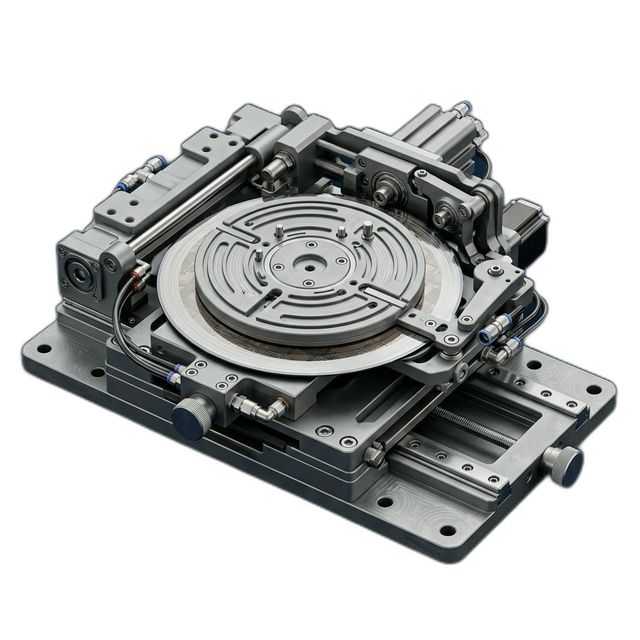
A metrology equipment maker building wafer inspection tools needed a stage mount that supports the objective lens assembly above the wafer. Any vibration or thermal drift in the mount shifts the focal plane and degrades inspection resolution below the tool’s sub-micron detection limit — the mount must be thermally stable, kinematically deterministic, and completely non-magnetic.
The Challenge
Three kinematic mounting surfaces — a flat, a vee, and a cone — must be positioned within ±0.0002″ to create a deterministic constraint system. Surface finish on kinematic contacts must be ≤4 Ra for repeatable seating. The mount must be non-magnetic: any residual magnetism from machining (cold working) must be below 2 Gauss to avoid interfering with electromagnetic stage actuators.
Our Approach
Started with solution-annealed 316L billet verified non-magnetic before first cut. Light finishing cuts to minimize cold work that can induce magnetism in austenitic stainless. Kinematic surfaces ground after milling for ≤4 Ra. Degaussed after machining and verified with a Gauss meter at <0.5 Gauss residual. All surfaces cleaned to semiconductor cleanliness spec.
The Result
Kinematic surfaces within ±0.00015″ (spec ±0.0002″). Residual magnetism <0.5 Gauss — well below the 2 Gauss limit. Customer measured stage repeatability at ±50nm and met tool spec on first integration.
Why Kinematic Mounts Matter in Wafer Inspection
A wafer inspection tool detects defects as small as 50nm on a 300mm wafer. The objective lens must be positioned with nanometer-level repeatability relative to the wafer surface. The stage mount is the structural interface between the objective lens assembly and the tool frame — it defines the position and orientation of the lens in six degrees of freedom. Any error in the mount propagates directly to the inspection image as focal shift, tilt, or positional offset.
Kinematic mounting is the standard approach for deterministic positioning in precision instruments. Three contact surfaces — a flat, a vee, and a cone — constrain exactly six degrees of freedom with no over-constraint. When the lens assembly is seated into the kinematic mount, it always returns to exactly the same position, regardless of how many times it’s removed and reinstalled. But this only works if the kinematic surfaces are machined to the correct position and have a surface finish smooth enough to ensure repeatable seating without micro-slip.
The Magnetism Problem in 316L Stainless
316L stainless steel is nominally austenitic and non-magnetic. It’s the standard material for precision components near electromagnetic actuators because it won’t create stray magnetic fields that interfere with stage positioning. But austenitic stainless has a dirty secret: cold work from machining can transform a percentage of the austenite phase to martensite, which is ferromagnetic. Heavy cuts, aggressive feeds, and work-hardened surfaces can produce enough martensitic transformation to make the part measurably magnetic.
In a wafer inspection tool, the stage uses electromagnetic linear motors to position the wafer with nanometer precision. A magnetic mount near those motors creates a stray field that applies a force on the stage — a force that varies with stage position, creating a position-dependent error that the control system can’t easily compensate. The customer’s spec was clear: residual magnetism below 2 Gauss, measured at the surface of each kinematic contact.
How We Solved It
The machining strategy had to balance three competing requirements: tight dimensional accuracy on the kinematic surfaces, ultra-fine surface finish, and minimal cold work to preserve the non-magnetic state:
- Solution-annealed billet, verified non-magnetic. We started with 316L billet that had been solution-annealed at 1,950°F to fully dissolve any martensite and maximize the austenite phase fraction. Before making the first cut, we verified the billet with a Gauss meter — zero detectable magnetism. This baseline ensures that any magnetism in the finished part comes from our machining process, not from the raw material.
- Light finishing cuts to minimize cold work. We roughed the part to within 0.010″ of final dimensions using conventional parameters, then switched to light finishing passes with sharp, positive-rake carbide inserts. The finishing depth of cut was limited to 0.002″ per pass with high surface speed to minimize the deformation zone. Less deformation means less austenite-to-martensite transformation at the surface.
- Surface grinding for kinematic contacts. The three kinematic surfaces — flat, vee, and cone — were ground after CNC milling. Grinding with a fine-grit aluminum oxide wheel achieves ≤4 Ra surface finish while removing the cold-worked layer from milling. The ground surface is both smoother (for repeatable seating) and less magnetic (because the deformed layer has been removed).
- Degaussing and verification. After all machining and grinding, every mount was passed through a degaussing coil to neutralize any residual magnetic field. We then verified each part with a calibrated Gauss meter at multiple points on each kinematic surface. All four mounts measured <0.5 Gauss — well below the 2 Gauss spec. The degaussing report shipped with each part.
- Electropolish and semiconductor-grade cleaning. All surfaces were electropolished for corrosion resistance and to remove any remaining surface contaminants. Final cleaning followed semiconductor cleanliness protocols — ultrasonic clean in DI water, nitrogen dry, and cleanroom packaging to prevent re-contamination before installation.
Stage Repeatability Results
The customer installed all four mounts in their wafer inspection tools and ran stage repeatability qualification tests. Using laser interferometry, they measured stage repeatability at ±50nm — within the tool’s design spec. The kinematic mount seated repeatably with no detectable hysteresis over 1,000 cycles of remove-and-reinstall testing.
The magnetic performance was equally critical: with the mounts installed, the stage showed no position-dependent magnetic error above the noise floor of the measurement system. The customer confirmed that the <0.5 Gauss residual magnetism was the lowest they had measured on any machined 316L component from any vendor.
What the Customer Said
“Most machine shops don’t understand that machining 316L can make it magnetic. RivCut not only understood the problem but had a process to prevent it — light cuts, grinding, and degaussing. The mounts met our magnetic spec with margin, and the kinematic repeatability is excellent. These are our reference mounts for the new tool platform.”
By the Numbers
Upload Your CAD File
Get instant AI pricing, a free DFM review, and full documentation on every order.
100% Made in USA · Never brokered · Ships anywhere in the US