Why Deep Pockets Are Hard to Machine
A deep pocket is any pocket where the depth is more than twice the tool diameter. At that point, things get tricky fast.
The tool sticks out far from the holder. More stickout means more deflection. More deflection means chatter, bad surface finish and broken tools.
Chips pile up at the bottom. They get re-cut, which generates heat. Heat kills tools and warps parts.
Coolant cannot reach the cutting edge. The deeper you go, the harder it is to keep the tool cool. Without coolant, tool life drops fast.
Do not use the same toolpath for deep pockets that you use for shallow ones. Standard pocket toolpaths bury the tool in material and cause tool breakage at depth.
Depth-to-Width Ratios
The depth-to-width ratio tells you how hard a pocket will be. Divide the pocket depth by the narrowest width. The higher the ratio, the harder the job.
| Depth-to-Width Ratio | Difficulty | Strategy Needed | Typical Tool |
|---|---|---|---|
| 1:1 to 2:1 | Easy | Standard pocket toolpath | Standard end mill |
| 2:1 to 4:1 | Moderate | Reduced stepover, slower feeds | Standard or long-reach end mill |
| 4:1 to 6:1 | Hard | Trochoidal or adaptive clearing | Extended-reach end mill |
| 6:1 to 8:1 | Very Hard | Specialized toolpaths + through-spindle coolant | Necked-down extended-reach tool |
| Over 8:1 | Extreme | EDM may be better choice | Sinker EDM or wire EDM |
If you can widen a pocket by even a few millimeters, do it. Going from a 5:1 ratio to a 4:1 ratio makes the job far easier. That small change can cut machining time in half. See our DFM guide for more pocket design rules.
Choosing the Right Tool
The tool makes or breaks deep pocket work. Pick wrong and you will fight chatter the entire job.
Rule 1: Shortest Possible Stickout
Use the shortest tool that can reach the bottom. Every extra inch of stickout multiplies deflection. If the pocket is 2 inches deep, do not use a tool that sticks out 4 inches.
Rule 2: Necked-Down Shanks
Extended-reach tools have a narrow neck above the flutes. The neck clears the pocket walls without rubbing. This lets you use a shorter overall length while still reaching deep.
Rule 3: Carbide Over HSS
Carbide is stiffer than HSS. It deflects less at the same length. For deep pockets, always use solid carbide end mills.
| Tool Feature | Why It Matters | When to Use |
|---|---|---|
| Standard length | Least deflection, best finish | Pockets under 2:1 ratio |
| Long reach | Reaches deeper without losing rigidity | Pockets 2:1 to 4:1 |
| Necked-down shank | Clears walls, reduces rubbing | Pockets 4:1 to 6:1 |
| Extended reach + reduced neck | Maximum depth with minimum deflection | Pockets 6:1 to 8:1 |
| Tapered end mill | Adds stiffness through taper | Draft-angle pockets in molds |
Flute Count
Use 3-flute end mills for aluminum. The wider flute valleys clear chips faster. Use 4 or 5 flutes for steel and stainless. More flutes mean higher feed rates in harder materials.

Trochoidal Milling
Trochoidal milling is the single best strategy for deep pockets. It uses small circular loops instead of straight passes.
The tool traces a series of overlapping arcs as it moves forward. Each arc only engages a small portion of the tool. This keeps cutting forces low and constant.
Why It Works for Deep Pockets
- Low radial engagement, The tool never buries itself in material. Less engagement means less deflection.
- Constant chip load, No sudden spikes in cutting force. The tool loads evenly on every arc.
- Higher feed rates, You can run 2-3x faster than conventional pocketing because the engagement is so light.
- Better chip evacuation, The circular motion throws chips away from the cut. They do not pile up at the bottom.
- Less heat, The tool spends less time in contact with material on each revolution. It has time to cool between arcs.
| Parameter | Trochoidal Milling | Conventional Pocketing |
|---|---|---|
| Radial engagement | 5-15% of tool diameter | 50-100% of tool diameter |
| Axial depth of cut | Full flute length (1-2x diameter) | 0.5-1x diameter |
| Feed rate | 2-3x higher | Standard |
| Tool load | Constant and predictable | Variable, spikes in corners |
| Tool life | 2-5x longer | Standard |
| Best for | Slots, deep pockets, hard materials | Shallow open pockets |
Trochoidal milling sounds slower because of the looping path. It is actually faster because you cut deeper per pass and run higher feeds. The total cycle time is usually shorter.
Adaptive Clearing
Adaptive clearing is the smart cousin of trochoidal milling. Your CAM software calculates the optimal stepover in real time.
The software looks at how much material the tool will hit on the next move. It adjusts the path to keep the chip load constant. When the tool enters a corner, the stepover shrinks. When it moves along a straight wall, the stepover grows.
When to Use Adaptive vs Trochoidal
- Trochoidal, Best for slots and narrow channels. The looping path works well when there is no room for wide stepovers.
- Adaptive, Best for open pockets with complex shapes. The variable stepover clears material faster than fixed-loop trochoidal paths.
Most modern CAM software supports both. Fusion 360 calls it "Adaptive Clearing." Mastercam calls it "Dynamic Milling." Hypermill calls it "Trochoidal Milling." The names differ, but the concept is the same.
Fusion 360: Adaptive Clearing. Mastercam: Dynamic Milling / OptiRough. Hypermill: Trochoidal Milling. SolidCAM: iMachining. They all maintain constant chip load, just with different algorithms.
Chip Evacuation
Chips are the number one killer of deep pocket operations. If chips pile up, bad things happen fast.
Re-cutting chips generates heat. Heat softens the tool coating. Soft coating wears faster. Worn tools deflect more. More deflection means worse finish and broken tools. It is a downward spiral.
How to Get Chips Out
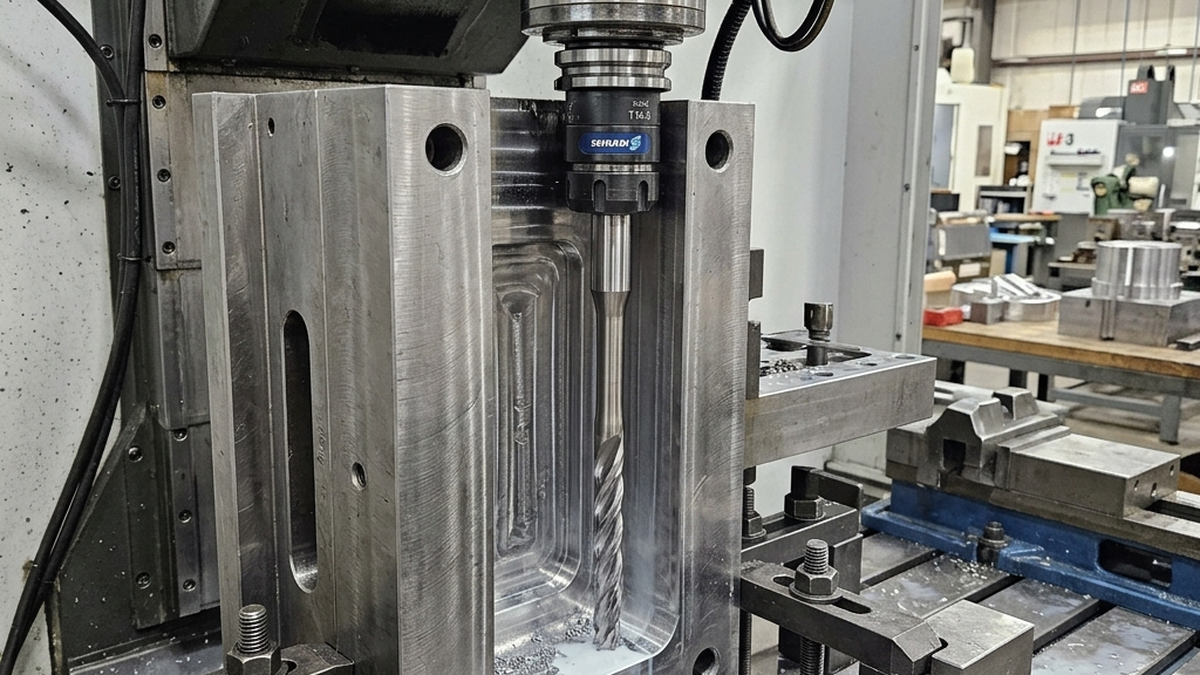
- Use air blast or through-spindle coolant, Pressurized air or coolant pushes chips up and out of the pocket.
- Program retract moves, Pull the tool out of the pocket every 2-3 passes. This clears chips that air alone cannot move.
- Avoid full-slot cutting, When the tool fills the entire slot width, chips have nowhere to go. Use trochoidal milling instead.
- Ramp into the pocket, Do not plunge straight down. A helical ramp or linear ramp entry gives chips a path to escape.
- Climb mill when possible, Climb milling throws chips behind the tool, away from the cutting zone.
If you hear a crackling sound during cutting, chips are being re-cut. Stop and clear the pocket before continuing. Re-cutting chips is the fastest way to destroy an expensive carbide end mill.
Coolant Strategies
The right coolant delivery can double your tool life in deep pockets. The wrong setup wastes coolant and does nothing.
| Coolant Type | Effective Depth | Pros | Cons |
|---|---|---|---|
| Flood coolant | Up to 2x tool diameter | Cheap, widely available | Cannot reach deep pocket bottoms |
| Air blast | Up to 4x tool diameter | No cleanup, good chip clearing | No cooling effect, dry machining only |
| Mist coolant (MQL) | Up to 4x tool diameter | Light lubrication, less mess | Limited cooling, not for heavy cuts |
| Through-spindle coolant | 8x+ tool diameter | Reaches the cut, clears chips, cools | Requires compatible spindle and tooling |
Through-Spindle Coolant (TSC)
TSC delivers coolant through holes in the tool itself. The fluid exits right at the cutting edge. This is the gold standard for deep pockets.
TSC does three things at once. It cools the tool. It lubricates the cut. And it blasts chips up and out of the pocket. No other method does all three.
You need a spindle that supports TSC. You also need end mills with coolant-through holes. The investment pays for itself quickly on deep pocket work.
Dry Machining with Air Blast
For aluminum, air blast often works better than flood coolant. Aluminum chips are sticky when wet. Dry chips fly away cleanly. Run high air pressure (80-100 PSI) aimed directly into the pocket.
Step-by-Step: How to Machine a Deep Pocket
Here is the process we use at RivCut for pockets with a 4:1 ratio or higher.
- Check the ratio. Measure depth divided by narrowest width. If it exceeds 4:1, plan for special toolpaths.
- Pick the tool. Choose the shortest carbide end mill that reaches the bottom. Use a necked-down shank if the ratio exceeds 4:1.
- Set up the toolpath. Use trochoidal or adaptive clearing. Set radial engagement to 8-12% of tool diameter. Set axial depth to full flute length.
- Set up chip evacuation. Enable through-spindle coolant or air blast. Add retract moves every 2-3 depth levels.
- Rough in steps. Take the pocket down in depth increments. Rough each level before going deeper. Leave 0.010" to 0.020" stock for finishing.
- Finish pass. Run the finish pass at full depth with light radial engagement (3-5% of tool diameter). Use a fresh tool or a dedicated finishing tool.
- Inspect. Check pocket depth, wall straightness and corner radii. Listen for chatter during cutting and adjust if needed.
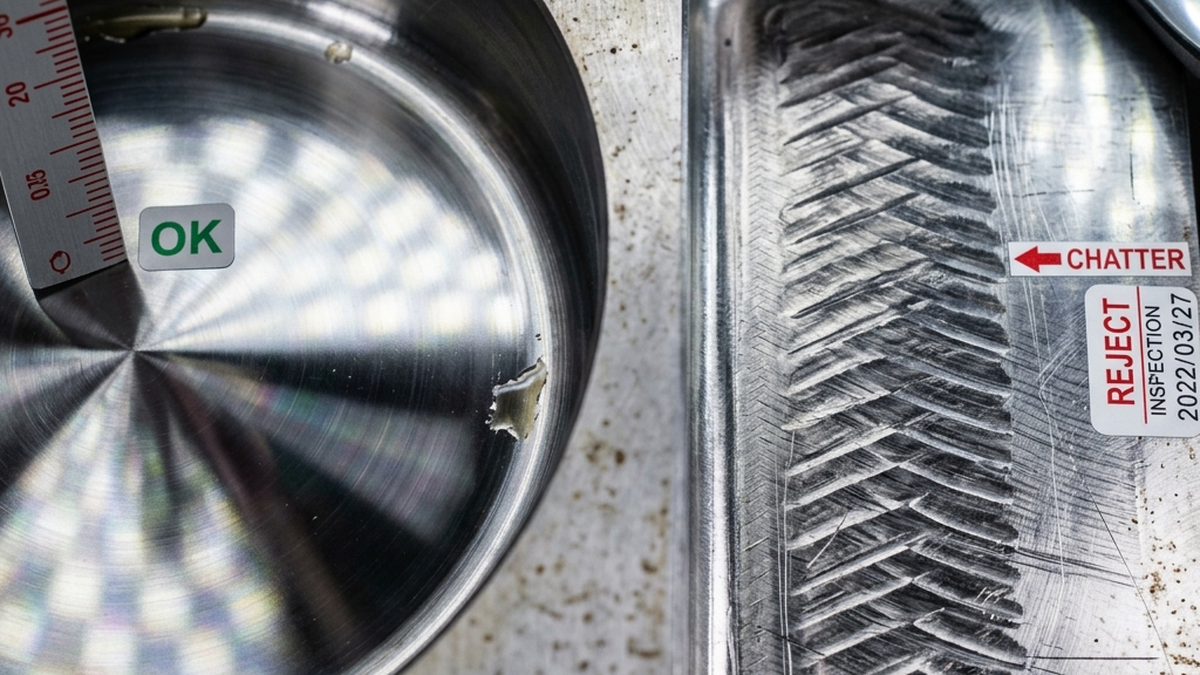
Run the first part slow. Watch it. Listen for chatter. Check the chips. Are they the right color? Silver chips in aluminum are good. Blue or brown chips in steel mean too much heat. Adjust before running the full batch.
5 Common Mistakes
- Using standard pocket toolpaths. Standard paths bury the tool at full width. This works fine at 1:1 ratio. At 4:1, it snaps the tool.
- Too much stickout. Machinists grab the longest tool to be safe. But longer tools deflect more. Use the shortest tool that fits.
- Ignoring chip evacuation. Chips build up silently. By the time you hear problems, the tool is already damaged.
- Plunging straight in. A straight plunge traps the tool in material with no exit path for chips. Always ramp or helix into the pocket.
- Skipping the finish pass. The roughing pass leaves scallops and deflection marks. A light finish pass at full depth cleans everything up.
Frequently Asked Questions
What is the maximum depth-to-width ratio for CNC milling?
A safe limit is 4:1 with standard tools. With extended-reach tools and trochoidal toolpaths, you can push to 6:1 or 8:1. Beyond 8:1, consider EDM instead.
What is trochoidal milling?
Trochoidal milling uses small circular arcs instead of straight passes. It keeps tool engagement low and constant. This reduces forces and extends tool life in deep pockets.
How do you get chips out of a deep pocket?
Use through-spindle coolant or high-pressure air blast. Program retract moves every few passes. Use climb milling to throw chips behind the tool. Never let chips pile up at the bottom.
What is adaptive clearing?
Adaptive clearing adjusts the stepover in real time to keep chip load constant. Your CAM software calculates the path based on remaining material. It prevents force spikes that break tools.
Should I use flood coolant or through-spindle for deep pockets?
Through-spindle is better. Flood coolant cannot reach pockets deeper than about 2x the tool diameter. Through-spindle delivers fluid right to the cutting edge and blasts chips out.
What causes chatter in deep pocket milling?
Chatter comes from vibration. Too much stickout, too heavy a radial cut, or the wrong spindle speed all cause it. Reduce radial engagement, shorten the tool and adjust RPM to fix it.