What Is Kerf?
Kerf is the width of material the laser beam removes. Think of it like the blade thickness on a saw. The laser melts and blows away a thin strip of metal along the cut path.
Kerf matters because it shifts your final dimensions. If you do not account for kerf, your part will be slightly smaller than the drawing says.
| Laser Type | Typical Kerf Width | Best For |
|---|---|---|
| Fiber Laser | 0.006" - 0.012" (0.15-0.3mm) | Thin metals, fine detail |
| CO2 Laser | 0.008" - 0.020" (0.2-0.5mm) | Thick metals, non-metals |
Good laser shops compensate for kerf automatically in their nesting software. But you should still know the kerf width for your material. It affects minimum feature sizes and slot widths.
Achievable Tolerances by Material and Thickness
Thicker materials are harder to cut accurately. The laser beam widens as it travels through the material. Here is what to expect.
| Material | Thickness | Typical Tolerance | Edge Quality |
|---|---|---|---|
| Mild Steel | 0.5-3mm | ±0.004" (0.1mm) | Excellent |
| Mild Steel | 3-6mm | ±0.006" (0.15mm) | Good |
| Mild Steel | 6-12mm | ±0.010" (0.25mm) | Fair |
| Mild Steel | 12-25mm | ±0.020" (0.5mm) | Rough |
| Stainless Steel | 0.5-3mm | ±0.004" (0.1mm) | Excellent |
| Stainless Steel | 3-10mm | ±0.008" (0.2mm) | Good |
| Aluminum | 0.5-3mm | ±0.005" (0.13mm) | Good |
| Aluminum | 3-6mm | ±0.010" (0.25mm) | Fair |
| Aluminum | 6-12mm | ±0.015" (0.4mm) | Rough |
Edge Quality
Laser-cut edges are not the same as machined edges. The quality depends on material, thickness and laser settings.
- Thin steel (under 3mm), Smooth, almost burr-free edges. Little to no post-processing needed.
- Medium steel (3-10mm), Slight roughness on the bottom edge. Light deburring may be needed.
- Thick steel (over 10mm), Noticeable taper and roughness. The entry side is wider than the exit side.
- Aluminum, More dross (melted material) on the bottom edge. Always needs deburring.
Edge Taper
Laser cuts are not perfectly square. The beam is slightly conical. On thin materials, taper is unnoticeable. On 12mm+ steel, taper can reach 0.5 degrees. If you need square edges on thick parts, CNC machining is the better choice.
Heat-Affected Zone (HAZ)
The HAZ is the area next to the cut where heat changes the metal. It gets harder and more brittle. This matters for parts that need to be welded, bent, or used in fatigue-critical applications.
| Material | Laser Type | Typical HAZ Width |
|---|---|---|
| Mild Steel | Fiber | 0.005" - 0.010" (0.13-0.25mm) |
| Stainless Steel | Fiber | 0.004" - 0.008" (0.1-0.2mm) |
| Aluminum | Fiber | 0.008" - 0.015" (0.2-0.4mm) |
| Mild Steel | CO2 | 0.010" - 0.020" (0.25-0.5mm) |
If your part will be bent along the laser-cut edge, the HAZ can cause cracking. Add extra material and machine the edge after cutting. Or move the bend line away from the cut edge.
Laser Cutting vs CNC Machining
Laser cutting and CNC machining serve different purposes. Here is a straight comparison.
| Factor | Laser Cutting | CNC Machining |
|---|---|---|
| Best tolerance | ±0.004" (0.1mm) | ±0.001" (0.025mm) |
| Part geometry | 2D profiles only | Full 3D features |
| Speed (simple parts) | Very fast | Slower |
| Material thickness limit | ~25mm steel | No practical limit |
| Edge quality | Good to fair | Excellent |
| Cost (flat parts) | Lower | Higher |
| Features (holes, threads, pockets) | 2D only, no threads | All features possible |
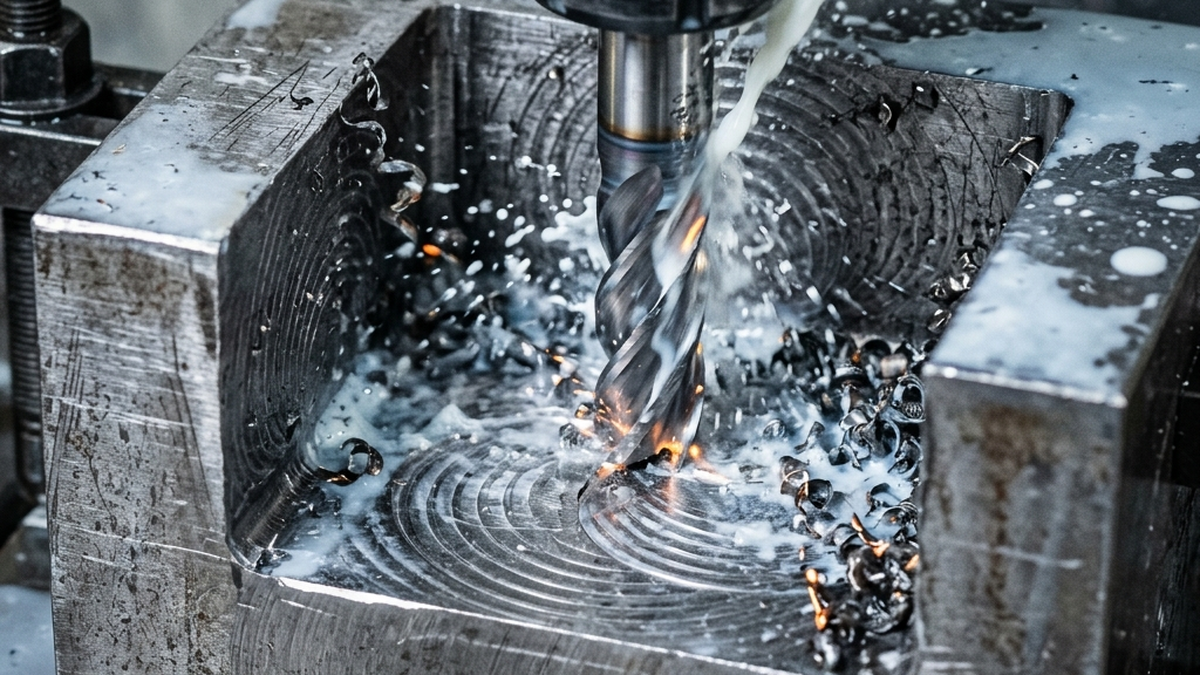
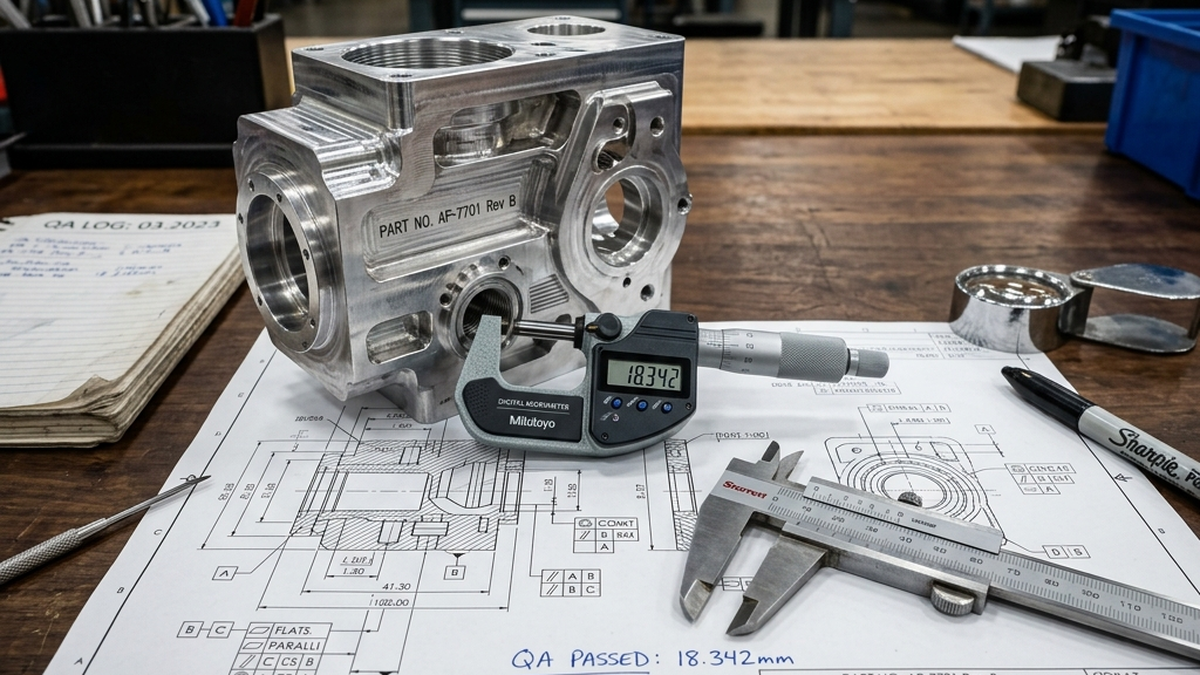
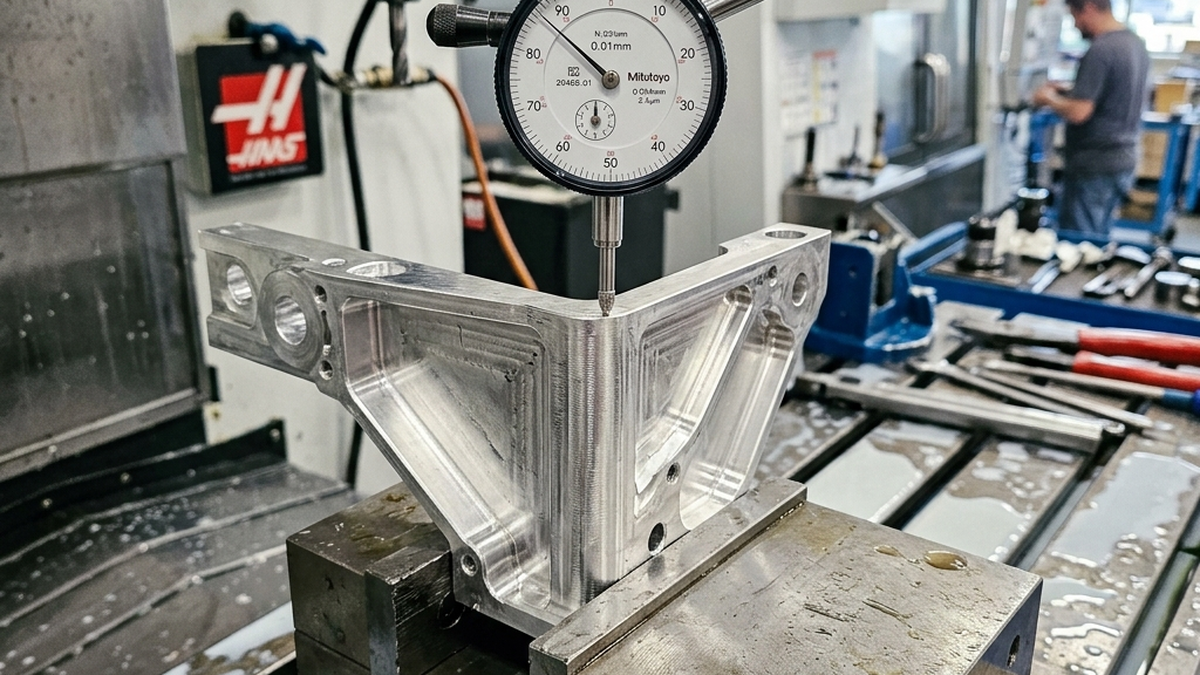
Many parts use both processes. Laser cut the blank, then CNC machine the critical features. This saves money on the 2D profile while getting CNC accuracy where it counts.
For general DFM guidelines that apply to both laser and CNC, see our complete guide.
Design Tips for Laser Cutting
- Minimum hole diameter, Keep holes at least 1x the material thickness. A 3mm thick sheet needs 3mm minimum hole diameter.
- Minimum slot width, Same rule. Slot width should be at least 1x material thickness.
- Edge-to-edge distance, Keep features at least 1x material thickness apart. Closer features cause heat buildup.
- Tab connections, If parts stay connected in the sheet, make tabs at least 2x material thickness wide.
- Text and fine detail, Minimum line width is about 0.5mm. Smaller text will fill in or burn away.
- Avoid sharp inside corners, Add a small radius (0.5mm minimum) to inside corners. Sharp corners concentrate heat and can cause micro-cracking.
Need tighter tolerances than laser cutting can deliver? Upload your part to RivCut for a CNC machining quote. We hold plus or minus 0.001" all day long.
Frequently Asked Questions
What tolerance can laser cutting achieve?
Fiber lasers on thin metal hold plus or minus 0.004" (0.1mm). Tolerance gets looser as material gets thicker. At 12mm steel, expect plus or minus 0.020".
What is kerf in laser cutting?
Kerf is the width of material removed by the laser beam. Fiber lasers produce 0.006" to 0.012" kerf. CO2 lasers produce 0.008" to 0.020" kerf.
What is the heat-affected zone?
The HAZ is the area next to the cut where heat changes the metal. It can extend 0.005" to 0.020" from the edge. The HAZ makes the edge harder and more brittle.
Is laser cutting more accurate than CNC machining?
No. CNC machining holds plus or minus 0.001" routinely. Laser cutting holds plus or minus 0.004" at best. Use laser cutting for 2D profiles and CNC for tight tolerances.
What materials can be laser cut?
Fiber lasers cut steel, stainless, aluminum, brass and copper. CO2 lasers also cut wood, acrylic and plastics. Highly reflective materials need fiber lasers.