What Is Tolerance Stack-Up?
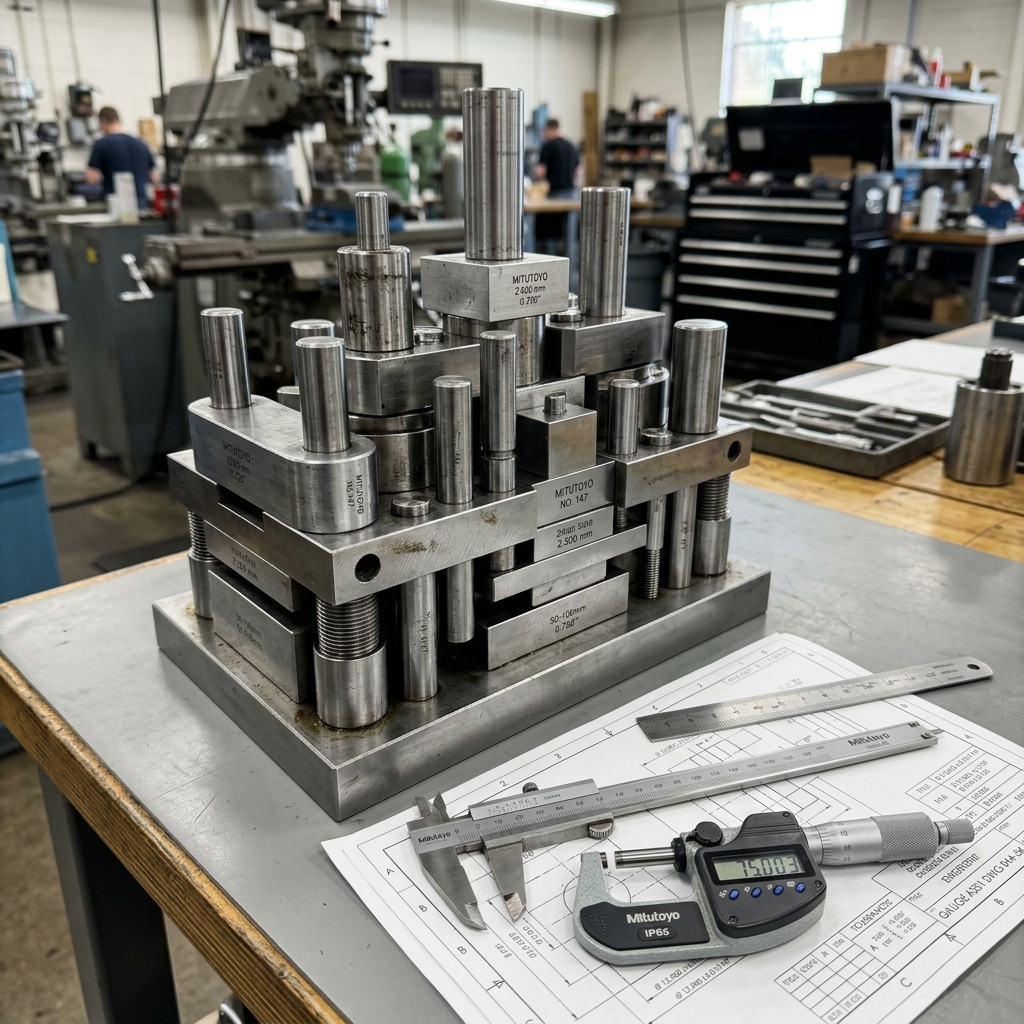
Tolerance stack-up happens when individual part tolerances combine in an assembly. Each part might be within spec on its own. But when you put them all together, the total variation can be larger than the gap you need.
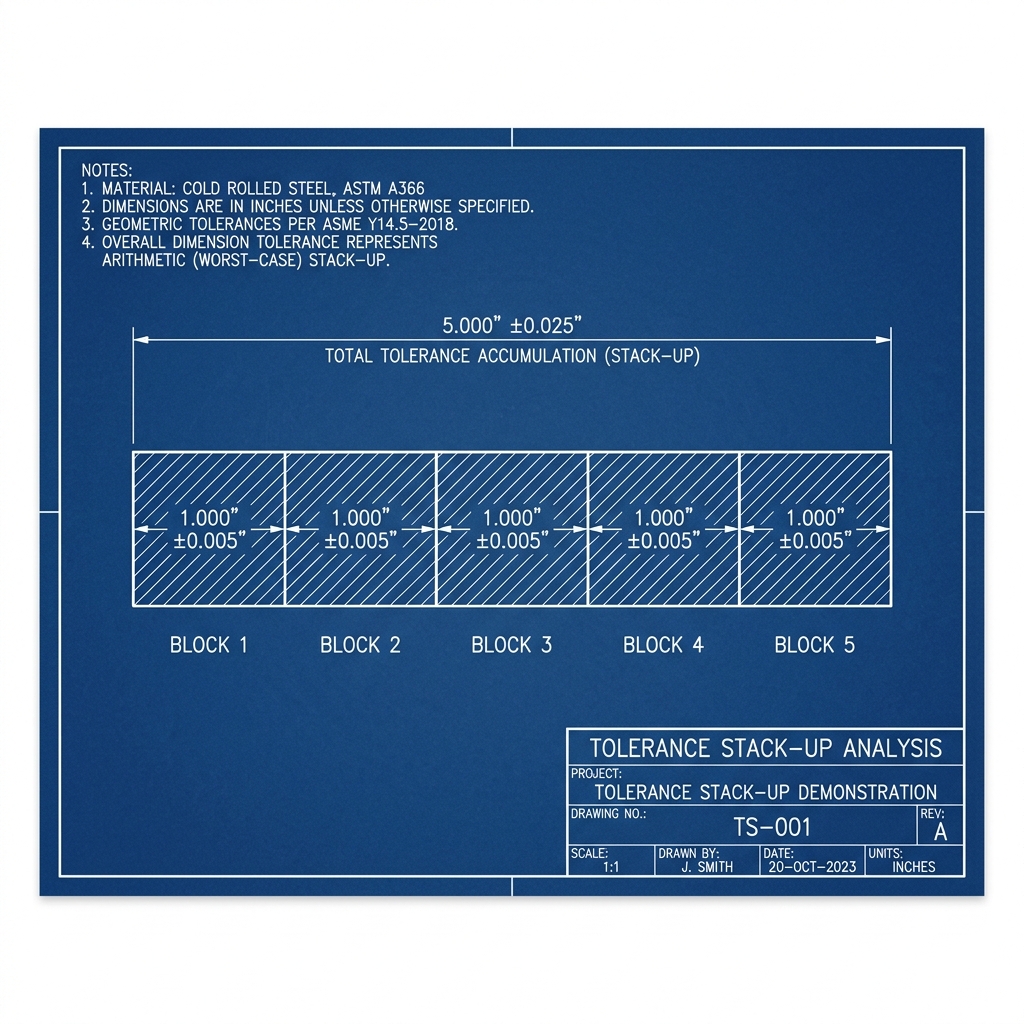
Think of it like stacking blocks. Each block is 1" tall with a +/-0.005" tolerance. One block could be anywhere from 0.995" to 1.005". Stack five blocks and the total height could range from 4.975" to 5.025" -- a total variation of 0.050".
Stack-up is the reason assemblies do not fit even when every single part passes inspection. The parts are all in spec. The assembly is not.
Worst-Case Stack-Up
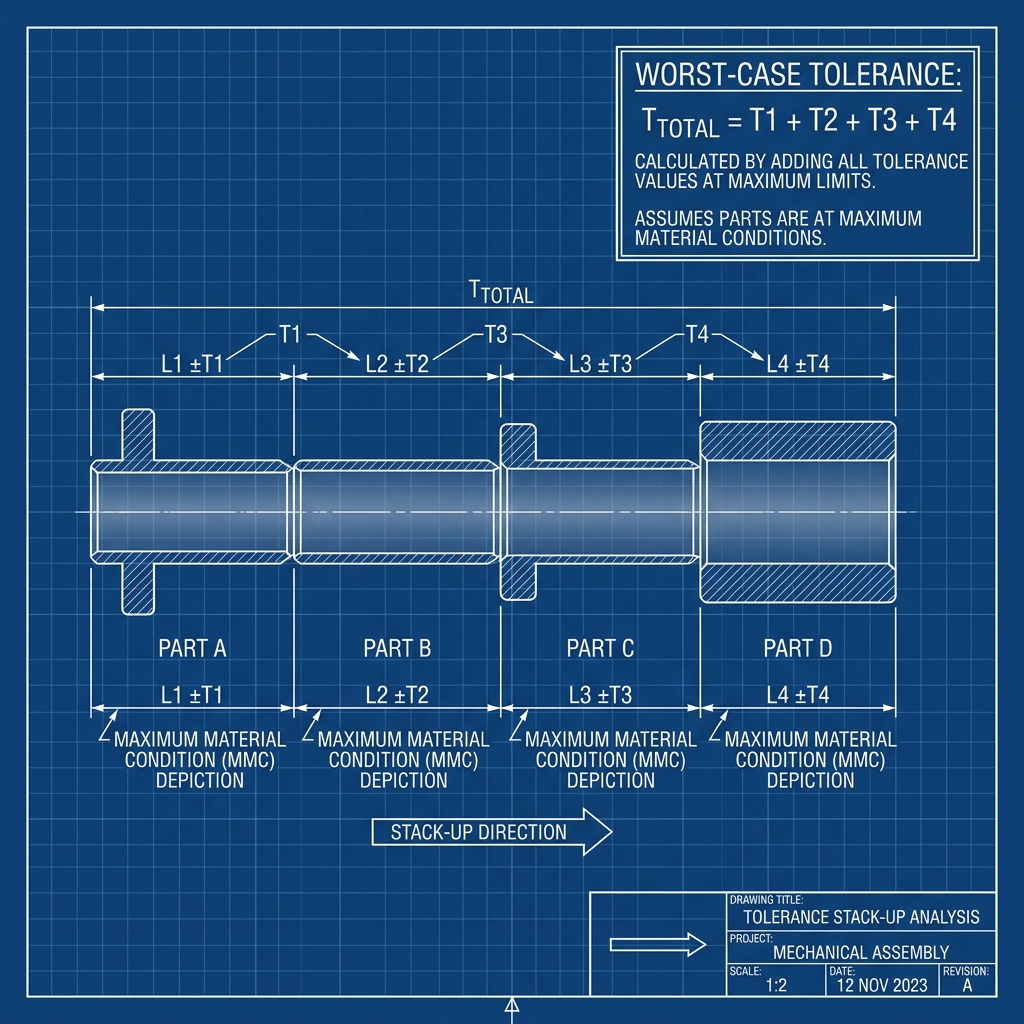
The worst-case method is simple. You add up all the tolerances. This gives you the maximum possible variation in the assembly.
Formula: Total tolerance = T1 + T2 + T3 + ... + Tn
Worst-case assumes every part is at the edge of its tolerance in the same direction at the same time. This almost never happens in real life. But it guarantees that every single assembly will work.
Use worst-case for safety-critical assemblies, low-volume production (under 50 units) and any assembly where 100% must work. This includes aerospace, medical and defense parts.
RSS (Root Sum Square) Stack-Up
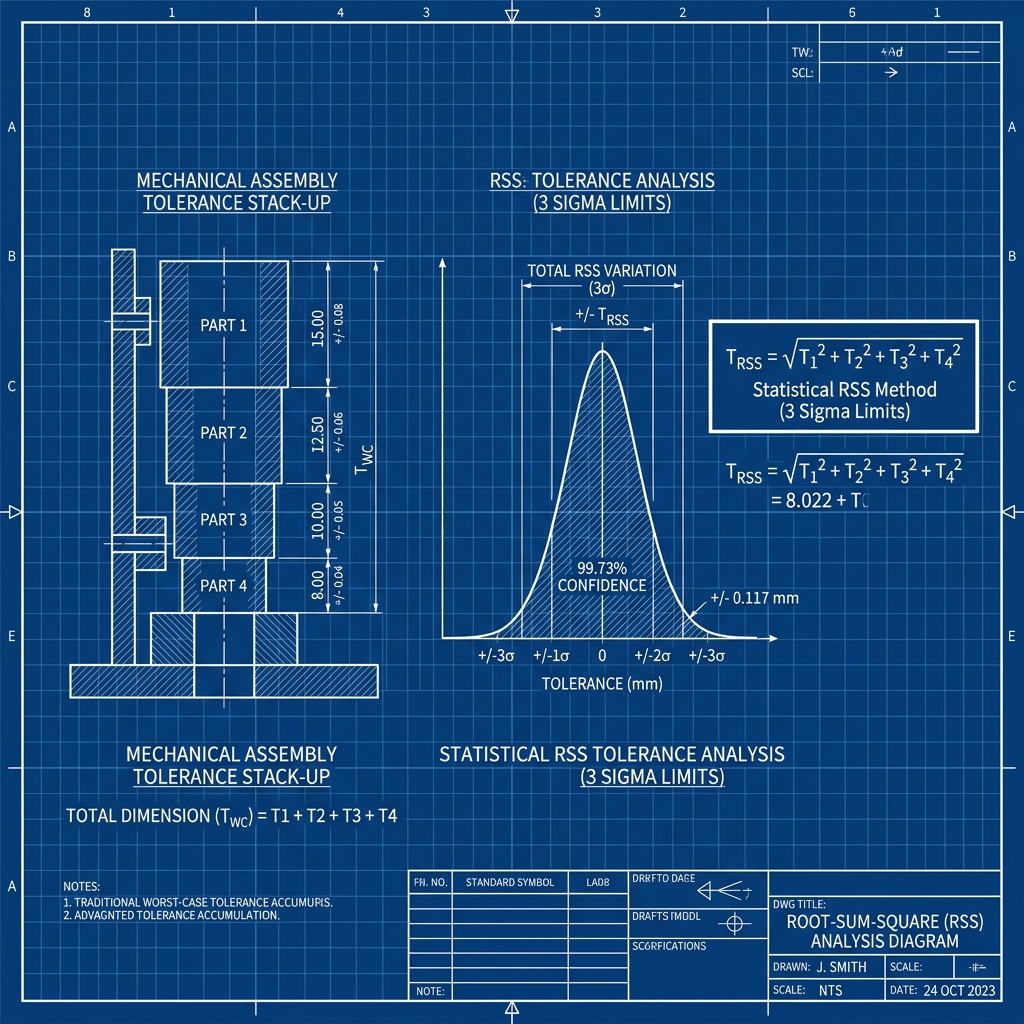
The RSS method uses statistics. It says that most parts will be near the middle of their tolerance range, not at the edges. So the total variation is smaller than worst-case.
Formula: Total tolerance = square root of (T1 squared + T2 squared + T3 squared + ... + Tn squared)
RSS covers about 99.73% of assemblies (3 sigma). That means about 3 out of every 1,000 assemblies might not fit. For high-volume production, this is usually acceptable.
| Method | 5 Parts at +/-0.005" | Coverage | Best For |
|---|---|---|---|
| Worst-Case | +/-0.025" | 100% | Safety-critical, low volume |
| RSS | +/-0.0112" | 99.73% | High volume production |
Notice the RSS result is less than half the worst-case result. That is the power of statistics -- and it is why RSS lets you use looser tolerances on individual parts.
Worked Example: Shaft Assembly
Let us look at a real example. You have a housing with a shaft that must have 0.002" to 0.010" of clearance (end play) after assembly.
Assembly Parts
| Part | Nominal | Tolerance |
|---|---|---|
| Housing bore depth | 2.000" | +/-0.003" |
| Bearing A width | 0.500" | +/-0.002" |
| Shaft shoulder width | 0.990" | +/-0.003" |
| Bearing B width | 0.500" | +/-0.002" |
Nominal gap = 2.000 - 0.500 - 0.990 - 0.500 = 0.010"
Worst-Case Analysis
Total tolerance = 0.003 + 0.002 + 0.003 + 0.002 = +/-0.010"
Gap range = 0.010 +/- 0.010 = 0.000" to 0.020"
Problem: the gap could go to zero. That means the shaft could bind. You need at least 0.002" of clearance, so this design fails the worst-case check.
RSS Analysis
Total tolerance = sqrt(0.003^2 + 0.002^2 + 0.003^2 + 0.002^2) = sqrt(0.000026) = +/-0.0051"
Gap range = 0.010 +/- 0.0051 = 0.0049" to 0.0151"
The RSS result says 99.73% of assemblies will have at least 0.0049" of clearance. If you are making hundreds of these, RSS says the design works.
If worst-case fails, you have options: tighten one or two of the most impactful tolerances, add a shim slot, or redesign to remove one part from the stack. Do not just switch to RSS to make the math work -- fix the root cause.
How Datums Break the Chain
A tolerance chain is a series of dimensions that link two features. The more links in the chain, the more tolerance accumulates.
Datums break the chain by creating a shared reference point. Instead of dimensioning each feature from the previous one (chain dimensioning), you dimension them all from the same datum surface.
- Chain dimensioning: Feature B is 1.000" from A. Feature C is 1.000" from B. The tolerance from A to C is T1 + T2.
- Baseline dimensioning: Feature B is 1.000" from datum A. Feature C is 2.000" from datum A. The tolerance from A to C is just T2 -- no accumulation.
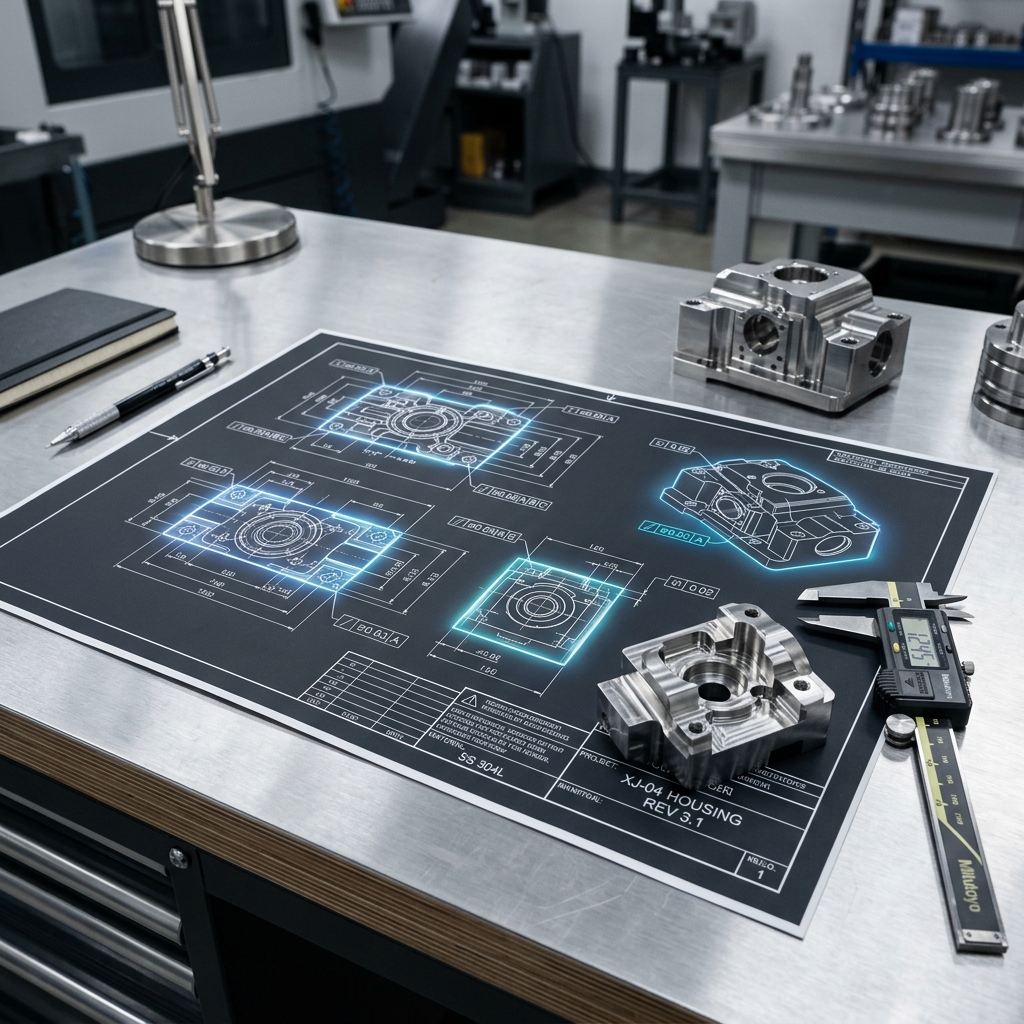
Any time you have three or more features in a line, use baseline dimensioning from a datum. It is the simplest way to prevent stack-up problems. Your engineering drawing callouts should show this clearly.
How to Reduce Stack-Up
- Fewer parts. Each part you remove from the stack removes a tolerance. Combine two parts into one where possible.
- Baseline dimensioning. Dimension from datums, not from other features.
- Tighten the biggest contributor. Use a tolerance sensitivity analysis to find which tolerance has the most impact. Only tighten that one.
- Add adjustability. Shims, set screws, or slotted holes let you adjust the assembly to compensate for stack-up.
- Match parts. In low volume, measure parts and pair them so a long part goes with a short housing.
- Use GD&T position tolerances. GD&T position callouts with datums control feature-to-feature relationships directly. See our GD&T reference for symbol definitions.
Frequently Asked Questions
What is tolerance stack-up?
Tolerance stack-up is when individual part tolerances combine in an assembly. Each part can be at the edge of its tolerance and those small variations add up to a larger total variation that can cause fit problems.
What is the difference between worst-case and RSS stack-up?
Worst-case assumes every part hits its max tolerance at once. RSS uses statistics to predict that most parts will be near nominal. Worst-case guarantees 100% assembly. RSS covers about 99.7%.
When should I use worst-case vs RSS?
Worst-case for safety-critical assemblies (aerospace, medical) where every unit must work. RSS for high-volume production where a small rejection rate is acceptable.
How do datums help with stack-up?
Datums create shared reference points. Dimensioning from datums instead of chaining dimensions prevents tolerances from accumulating across the part.
How many parts can stack up before it becomes a problem?
It depends on individual tolerances and your needed gap. Five parts at +/-0.005" create +/-0.025" worst-case. If your gap is only 0.020", four parts already cause trouble.